AUTHOR: Muriëlle van Hagen
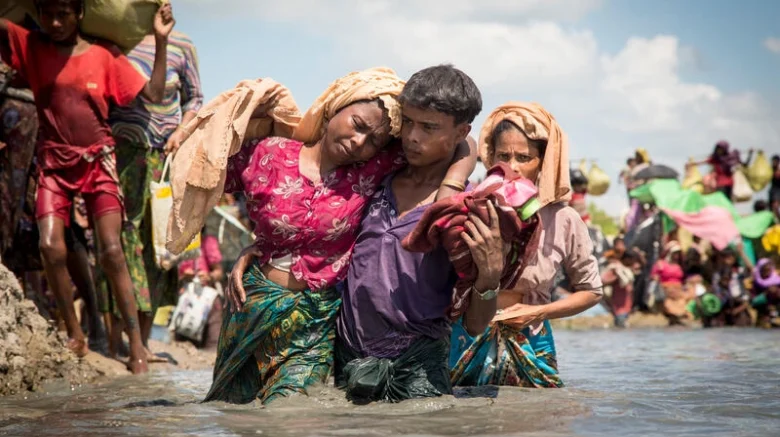
Dozens of Rohingya villages in Myanmar were surrounded and set on fire, in August 2017. People were shot, tortured, raped, or burned alive, leaving behind only corpses and ash. This was all part of an ethnic cleansing campaign by Myanmar’s military, in an attempt to permanently erase the Rohingya community from the country—causing over 740,000 to flee.
Who are the Rohingya?
The Rohingya are a mostly Muslim ethnic minority living in Myanmar. They live near the border with Bangladesh, mainly in Rakhine State, under poor and isolated living conditions. Although they have lived there for many generations, they are still not recognized as citizens by the government and are instead viewed as illegal immigrants, leaving them stateless and stripped of basic rights. They face systematic discrimination, restrictions on movement, and limited access to healthcare, education, and employment. The main driver of the tension between the Rohingya and the broader population is religion: the Rohingya are mostly Muslim, while the majority of Myanmar is Buddhist.
The Military Campaign of 2017
Myanmar’s security forces conducted a brutal and disproportionate “clearance operation” targeting the entire Rohingya population in northern Rakhine State, in response to deadly attacks by ARSA on approximately 30 security posts on 25 August 2017. ARSA, the Arakan Rohingya Salvation Army, is an armed Rohingya group.
Hours after the ARSA attacks, Myanmar security forces – often joined by Border Guard Police and local vigilantes – began surrounding dozens of Rohingya villages. People trying to flee were often shot and killed, while those unable to escape, such as the elderly and disabled, were burned alive as the military set entire villages on fire. Those who managed to reach the riverbank were followed by the military, then separated into groups: men and older boys, and women with young children. The men and boys were killed, along with some women and children. The remaining women and girls were taken to nearby houses, where they were abused, raped, and eventually burned alive.
Hundreds of thousands of innocent Rohingya women, men, and children became victims of this widespread and systematic attack, which aimed to permanently drive them out of the country. Entire communities were erased from the map – amounting to crimes against humanity. According to the Rome Statute of the International Criminal Court, there are 11 acts that constitute crimes against humanity. At least six of these were committed during the attacks on the Rohingya: murder, deportation and forcible displacement, torture, rape and other forms of sexual violence, persecution, and other inhumane acts such as denial of food and life-saving aid. Many did not survive the attacks, and around 740.000 fled to neighbouring Bangladesh. Considering previous waves of violence, an estimated one million Rohingya refugees now live in Bangladesh.
Following these attacks, the Myanmar government restricted aid from the UN and other organizations that could have provided water, food, and medical assistance to Rohingya victims. Other displaced ethnic minorities in Rakhine received aid from the Myanmar Government.
On their way to Bangladesh, fleeing Rohingya encountered military checkpoints set up by the security forces of Myanmar, where they were robbed, sexually abused, and forced to record videos falsely claiming that the military had not mistreated them.
Life in Refugee Camps
Many Rohingya remain in refugee camps in Bangladesh to this day, with the majority living in the Kutupalong camp—the largest refugee camp in the world. Living conditions are far from adequate: food insecurity is a growing problem, the economy is unstable, and access to healthcare and education is limited. Environmental disasters in the camps increase mortality, and overall security remains low due to rising gang-related violence.
In the Kutupalong camp, the largest refugee camp in the world, criminal gangs fight for control, putting residents—especially women—at risk. There are reports of women being forced into prostitution. Some Rohingya have also been relocated to an uninhabited island in the Bay of Bengal, where they face risks of flooding and fire. Access to education, healthcare, and drinking water is severely restricted, as are freedom of movement and assembly. Education for children is limited both in duration and content.
Because of these conditions, some refugees attempt dangerous sea routes to migrate to other countries in the hope of a better future. Besides that, staying in the camps is often the only option, since returning home is not safe under the current conditions. Rohingya still lack freedom and basic rights in Myanmar. Girls and young women are abducted, raising serious concerns about rape and sexual slavery. Myanmar’s military also deliberately creates food insecurity by blocking access to rice fields, stealing livestock and money, and burning food markets.
In 2024, violence against the Rohingya spiked again, in ways dangerously similar to the ethnic cleansing campaign of 2017. Innocent Rohingya are being killed, homes destroyed, towns emptied, infrastructure demolished, and the remnants of Rohingya history and identity are being erased.
A Continuing Human Rights Crisis
To this day, the Myanmar government has not acknowledged the brutal actions, and no high-ranking military officials have been prosecuted for the 2017 campaign against the Rohingya. Beyond the military leadership, all military personnel involved bear responsibility for these crimes. ARSA also bears responsibility for the attacks on 25 August 2017 and those that followed. However, there is no doubt that the Myanmar military carried out the most extreme and disproportionate violence against innocent Rohingya civilians
Holding those responsible within ARSA accountable is fair, but using those attacks as an excuse to murder, abuse, and torture countless innocent people is never justifiable. Rohingya refugees and victims deserve justice, their human rights must be respected, and most importantly, they must be able to safely and voluntarily return home with dignity.
Until that is possible, Bangladesh must prioritize protecting the human rights and safety of Rohingya refugees in camps and uphold the principle of non-refoulement.
It is time to give the Rohingya a safe home—something every human deserves.
Sources:
https://www.amnesty-international.be/nieuws/de-rohingya-wie-zijn-ze-en-waarom-ontvluchten-ze-myanmar
https://www.amnesty.ie/myanmar-rohingya-violence/
https://www.amnesty.org/en/latest/news/2022/08/myanmar-rohingya-five-year-anniversary/
https://www.amnesty.org.uk/blogs/country-specialists/worsening-conditions-rohingya-refugees
Source picture:
https://www.unhcr.org/news/stories/100-days-horror-and-hope-timeline-rohingya-crisis