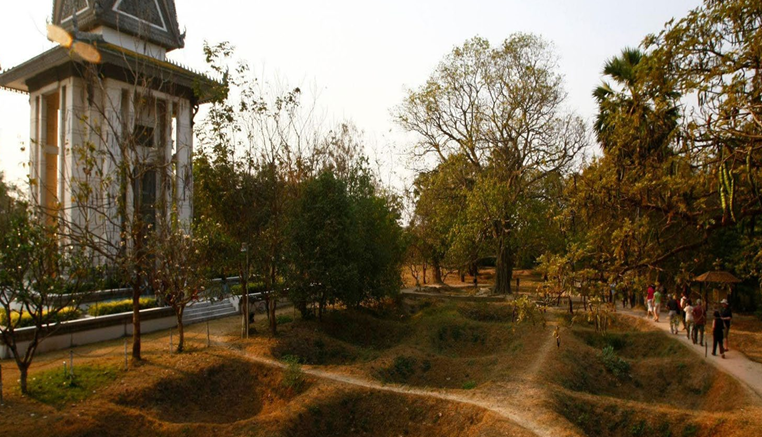
The mass graves and memorial stupa at Choeung Ek Genocidal Center.
AUTHOR: Adriano Barbaro
“Do you wear glasses?”, “Do you speak any foreign language?”, “Can you read or write?”, “Do you have relatives abroad?”, “Are you from the city?”, “What was your job before 1975?”. Those were the most feared questions in Cambodia between 1975 and 1979, during the Khmer Rouge regime in the country Giving the “wrong” answers could turn your life and your family’s lives into nightmares, often ending in mysterious disappearances or unlawful arrests. The story of the Khmer Rouge dictatorship under its leader, Pol Pot, is one of political extremism, unspeakable lies and ethnic cleansing. This article will try to bring this topic back into the spotlight, addressing the crimes and dynamics of one of the most brutal and rapidly executed campaigns of crimes against humanity ever witnessed.
The Rise of the Khmer Rouge
The Khmer Rouge were the Cambodian communist movement, formally linked to the Communist Party of Kampuchea and led by Pol Pot together with other figures who claimed to be building a radically new society. The movement’s rise cannot be separated from the political instability of Cambodia in the late 1960s and early 1970s. According to the United Nations, the Khmer Rouge’s armed struggle began in the late 1960s and accelerated after the March 1970 coup that overthrew Prince Norodom Sihanouk, creating the Khmer Republic. When the Khmer Rouge entered Phnom Penh on 17 April 1975, they renamed the country Democratic Kampuchea, which, as history will show, had very little in common with democracy.
At the centre of the Khmer Rouge ideology was the belief that Cambodian society had to be purified and restarted. The regime imagined a self-sufficient, agrarian and classless country. Cities were seen as corrupt, intellectuals as politically dangerous and minorities or religious leaders as potential threats. After all, who is easier to control: a cultured and unified population, or an uneducated and lost one? he Khmer Rouge knew the answer to that question and acted accordingly. In fact, the doctrine became policy. Leaders planned and orchestrated mass crimes to implement their revolution, including forced displacement from towns or villages, forced labour, mistreatment in cooperatives and worksites, arbitrary arrests, torture, disappearances and executions.
Therefore, the rise of the Khmer Rouge should not be understood only as the victory of a rebel movement, but rather as the beginning of a radical social experiment in which ideology became justification for mass violence.
“Year Zero”: Building an Agrarian Utopia
However, how did the Khmer Rouge implement their plan? How precisely did their ideology lead to the atrocities committed?
The answer lies in the idea of “Year Zero”. For the Khmer Rouge, taking power in April 1975 did not simply mean replacing one government with another. It meant restarting Cambodian history. The regime’s goal was to erase the old society and build a new one from nothing. Absolutely nothing. The ultimate society would look rural, self-sufficient, classless, obedient and purified of any foreign influence.
In this sense, “Year Zero” suggested rebirth but in reality it meant erasure. Cities, markets, money, schools, religion and family life were all treated as obstacles to the revolution. The old Cambodia had to disappear and make space for a new one, the Democratic Kampuchea. Central to this project was an extreme agrarian revolutionary communism. The Khmer Rouge idealised the peasantry as politically pure and saw urban life as corrupt, capitalist and foreign influenced. Intellectuals, professionals, religious figures, ethnic minorities and people connected to the previous regime could all be treated as enemies of the revolution.
This led to the evacuation of Phnom Penh, with families forced to move to the countryside. Private property and markets were abolished. People were reorganized into agricultural cooperatives and made to work under harsh conditions in the name of collective labour and national self-sufficiency.
The Killing Fields
However, this Year Zero ideology did not stop at displacing people outside of the cities to force them to work in the countryside, but it also produced a network of execution sites and mass graves that later became known as the killing fields. These were part of a wider system through which the Khmer Rouge identified and removed those considered as enemies of the revolution.
Victims were not only soldiers or political opponents. People could be targeted because they had worked for the previous government, lived in a city, were educated, belonged to a religious or ethnic minority, spoke a foreign language, or were accused of betrayal. Teachers, doctors, monks, students, former officials, ethnic Vietnamese people, Cham Muslims, children, the elderly and even Khmer Rouge cadres caught in internal purges became victims of the regime.
These people were not described as victims by the Khmer Rouge, but as traitors, spies, class enemies or foreign agents. Once people were reduced to those categories, their removal could be presented not as murder, but as the defence of a new society.
In many cases, people were arrested or taken away without explanation. Some were forced to confess to crimes they had not committed or to name others. Many were transported to execution sites, killed and buried in mass graves. At Choeung Ek, one of the most infamous Killing Fields, victims were brought from the Khmer Rouge security system and executed in large numbers. Tribunal evidence later found that at least 7,708 detainees were executed there.
The methods of killing also reveal the brutality and dehumanisation of the regime. Victims were often killed with agricultural tools, iron bars or knives rather than bullets, partly because ammunition was considered too valuable to waste. Also, using guns would have been louder than beating these people to death, and could have attracted unwanted attention. For many Cambodians at the time, the full scale of the killing was hidden by fear, secrecy and the regime’s control over information. The bodies were then placed in mass graves, turning ordinary fields into landscapes of hidden death.
The scale of the violence is difficult to comprehend. Amnesty International has reported that up to two million Cambodians died under Khmer Rouge rule, out of a population of approximately seven to eight million. The UN-backed Khmer Rouge tribunal investigated more than one hundred crime sites across the country. These numbers show that the Killing Fields were not an exception to the regime’s ideology; they were one of its clearest consequences.
Personal Reflection
Before moving along with this conclusive section, I want to make it clear that what follows reflects and delves into my own personal experience of getting in touch with this delicate topic. In fact, I visited Cambodia in August 2025, and on this trip I also got the chance to visit the Choeung Ek Genocidal Center. This has been one of the strongest experiences of my life and I will share what I witnessed that day.
To begin with, what struck me at first was the vastness of the field. You barely could see the end of it. Also, while going there, I had the feeling I was going to a place that many people, especially Western people, knew very little about. I also felt a kind of fear to get to know the real truth behind that site.
All senses were heavily challenged. By taking a closer look at the field you could easily recognize the mass graves that had been partially filled. The terrain was very irregular, with numerous furrows Also, emerging from the ground, you could still see some pieces of clothing belonging to the victims that were thrown into the ditches. Given that these tragic events happened only half a century ago, some textiles have not been dissolved yet.
The smell also was harsh. You could breathe something wrong in the air, something unusual. Given that it was all open air, all right under your nose, all the smells coming from the terrain were recognizable while breathing.
During my visit, the guide took us to some specific areas of the fields, while explaining to us what had happened there. Among the most haunting symbols of Choeung Ek is the so-called “Killing Tree”, where infants and young children were murdered before being thrown into mass graves. They were often killed because the regime feared they might grow up and seek revenge for their parents’ deaths. The tree stands today as a reminder that the Khmer Rouge’s violence did not spare even the youngest and most innocent victims.
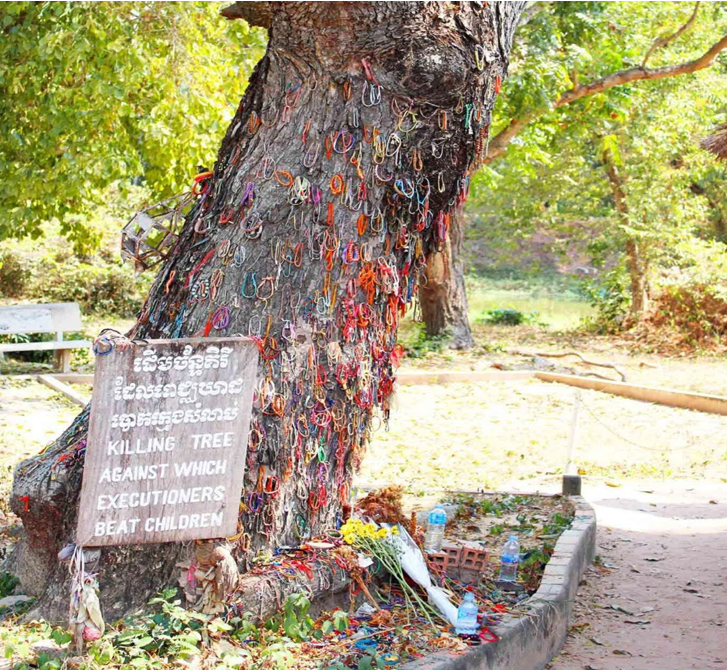
The “Killing Tree” at Choeung Ek, where children were murdered by Khmer Rouge executioners and where visitors now leave bracelets in remembrance.
This experience has been both touching and disturbing. This representation of relentless violence really marks you and reminds you of what humans have been capable of. However, it truly was inspirational to see how the Cambodian people acknowledged that period of time and moved on, with undeniable strength and solidarity. This has been the strongest message of all.
References
Amnesty International. (2009, March 27). Cambodia: After 30 years Khmer Rouge crimes on trial.
https://www.amnesty.org/en/documents/asa23/003/2009/en/
Amnesty International. (2009, March 27). Cambodia: An historic day for Khmer Rouge victims. https://www.amnesty.org/en/latest/press-release/2009/03/cambodia-historic-day-khmer-rougevictims-20090327/
Amnesty International. (2012, February 3). Cambodia: Khmer Rouge judgment welcome, but raises human rights concerns. https://www.amnesty.org/en/latest/news/2012/02/cambodia-khmer-rougejudgment-welcome-raises-human-rights-concerns/
Amnesty International. (2022, September 22). Cambodia: Verdict against former Khmer Rouge head of state upheld as tribunal nears end. https://www.amnesty.org/en/latest/news/2022/09/khmerrouge-tribunal-khieu-samphan/
Extraordinary Chambers in the Courts of Cambodia. (n.d.). Guide to the ECCC.
https://www.eccc.gov.kh/en/about/guide-to-eccc
Extraordinary Chambers in the Courts of Cambodia. (n.d.). Trial 002/02.
https://www.eccc.gov.kh/en/cases/case-002/trial-02
Extraordinary Chambers in the Courts of Cambodia. (n.d.). Voeun Vuthy: Witness profile. https://www.eccc.gov.kh/en/directory/witness-profile/voeun-vuthy
Extraordinary Chambers in the Courts of Cambodia. (n.d.). Extraordinary Chambers in the Courts of Cambodia. https://eccc.gov.kh/en
United Nations Office of Legal Affairs. (n.d.). Agreement between the United Nations and the Royal Government of Cambodia concerning the prosecution under Cambodian law of crimes committed during the period of Democratic Kampuchea. United Nations. https://legal.un.org/avl/ha/abunac/abunac.html
Source(s) image(s)
Bailliez, S. (2015, November 30). Chankiri Tree or Killing tree at Choeung Ek [Photograph]. Flickr. https://www.flickr.com/photos/sbailliez/23571857515
Shankar, S. (2014, April 1). Choeung Ek—one of the mass graves (14064614789 [Photograph]. Wikimedia Commons. https://commons.wikimedia.org/wiki/File:Choeung_Ekone_of_the_mass_graves(1406461479).jpg
