AUTHOR: Marco Piñeiro López
In 2022, after seven years of war, a UN-brokered truce finally brought some calm to Taiz. For a city that had been a battleground between the Huthis and government forces since 2015, it looked like the beginning of the end. However, that peace never fully arrived. Recently, Yemen became an arena for the wider war between the United States, Israel and Saudi Arabia on one side and Iran on the other, which also made an impact on Taiz. This October, the Huthis cut the main road that linked Taiz to the city of Aden and the horror returned to civilians’ lives.
Once Again…
The instability Yemen has faced since its unification in the 1990s has never stopped. Under Ali Abdullah Saleh’s government, the Huthi movement in the north of Yemen increased its protests and started their first attacks. After the change of government to Vice President Hadi in a transition that seemed peaceful but was deeply unstable, the Huthis seized the capital, while Hadi fled to the south. This is where Taiz comes in: Yemen’s third most populous city and a key gateway to the south and to the Bab el Mandeb Strait, which connects the Gulf of Aden with the Red Sea. In 2015 it was placed under a siege that left the city completely cut off.
After a few years of de-escalation thanks to the ceasefire, this October Yemenis and the people of Taiz have been placed in the line of fire once again. As international tensions erupted, the Huthis decided to once again cut the main road connecting Taiz to Aden, the seat of the internationally recognised government of Yemen, along with other major routes, cutting the city off from humanitarian aid. Taiz was already lacking food, water and medical supplies and now more than 800,000 civilians are being denied humanitarian assistance. Trapped inside the siege, civilians have been forced to take highly dangerous paths searching for help.
Battleground for World Powers
Yemen´s conflict has never been just a Yemeni war. Since the beginning, Saudi Arabia has led a military coalition backing the government, while Iran has supported the Huthis. For years, both sides fought each other on Yemeni soil and civilians paid the price. Saudi-led air strikes hit homes and hospitals while the Huthis shelled residential areas and launched missiles across the border.
In March 2023, peace talks between these two countries, mediated by China, ended with an agreement to restore diplomatic relations and to reopen their embassies after years of fighting. However, that agreement did not last long as following Israel´s action on Palestine, the Huthis declared that if the United States intervened in the conflict, the group would respond with military attacks. They began attacking ships in the Red Sea, the United States and the United Kingdom bombed Yemen, and the peace talks were frozen.
In early 2026, the United States and Israel launched military strikes against Iran. Iran retaliated by firing missiles at countries across the region, including Saudi Arabia. Then, in July, after an air strike on Sana´a airport, the Huthis declared a maritime blockade against Saudi Arabia, presenting it as a response to the Saudi restrictions on the ports and airports they control. The war soon returned to the ground, as the Huthis seized a large part of Yemen´s Red Sea coast and in October 2026 Taiz was again under siege.
Escalation of the Humanitarian Crisis
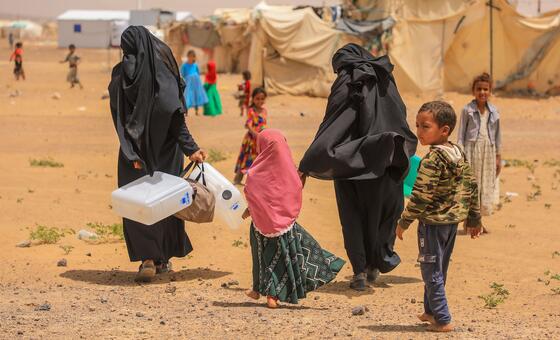
As in any conflict, it is the civilian population who suffers the most. Living in Taiz city has become a matter of survival: cooking gas is largely unavailable, food prices have risen about 50%, and wheat and flour supplies are expected to run out in less than three weeks.
The current situation has forced Yemenis to live under extremely unhealthy conditions as access to health services is practically impossible. Additionally, because many people now live in overcrowded shelters without safe drinking water or uncontaminated food, Yemen is facing a surge in cholera which has reportedly killed several civilians.
Aid Workers Face Death Penalty
The Huthis have been detaining and targeting UN staff for years, often holding them without any legal basis. Recently, a new line was crossed when Amnesty International and Human Rights Watch have stated that the Huthi de facto authorities will be prosecuting humanitarian aid workers and UN employees for espionage crimes that are punishable by death. According to witnesses, these detainees were forced to confess after days of torture or threats of torture. The level of inhumanity is hard to overstate: people providing medical and food assistance to civilians living in unimaginable conditions are now facing execution.
Amnesty International is calling on the Huthis to immediately open the roads in and around Taiz, halt the prosecutions, and release all those they are arbitrarily detaining, including aid workers. It also urges donor states to provide urgent and sufficient funding for Yemen’s humanitarian response, which has been severely underfunded for years, especially after the global aid cuts of 2025. The people of Taiz have already survived one siege and the international community must not let them face another one alone.
Sources
Amnesty International. (2026). Yemen 2025. In Amnesty International Report 2025/26. https://www.amnesty.org/en/location/middle-east-and-north-africa/middleeast/yemen/report-yemen/
Amnesty International. (2026, April 28). Yemen: One year on, impunity for detention centre strike exposes US failures on accountability and civilian harm prevention. https://www.amnesty.org/en/latest/news/2026/04/yemen-one-year-on-impunity-fordetention-centre-strike-exposes-us-failures-on-accountability-and-civilian-harmprevention/
Amnesty International. (2026, October 6). Yemen: Huthis Prosecute UN, Civil Society Staff. https://www.amnesty.org/en/latest/news/2026/10/yemen-huthis-prosecute-un-civilsociety-staff/as
Amnesty International. (2026, October 22). Yemen: Huthis must open Ta’iz roads immediately thousands of civilians’ lives are risk. https://www.amnesty.org/en/latest/news/2026/10/yemen-huthis-must-open-taiz-roadsimmediately-as-thousands-of-civilianslives-are-at-risk/at
Johnson, D. (2026, October 23). Yemen: Deepening concerns for Taiz City as aid is blocked from entering. UN News. https://news.un.org/en/story/2026/10/1168654
Security Council Report. (2026, November 2). Yemen. In November 2026 Monthly Forecast.
https://www.securitycouncilreport.org/monthly-forecast/2026-11/yemen92.php
UN News. (2023, April). Yemen health system ‘edging closer to collapse’ warns WHO. https://news.un.org/en/story/2023/04/1135922
UN News. (2026, October 13). Yemen: Houthi siege, cholera outbreak and aid cuts put civilians in the crosshairs. https://news.un.org/en/story/2026/10/1168589
Image:
IOM. (2026, September 15). Women and children who have fled conflict in Yemen go in search of water in Ta’iz. UN News. https://news.un.org/en/story/2026/09/1168343