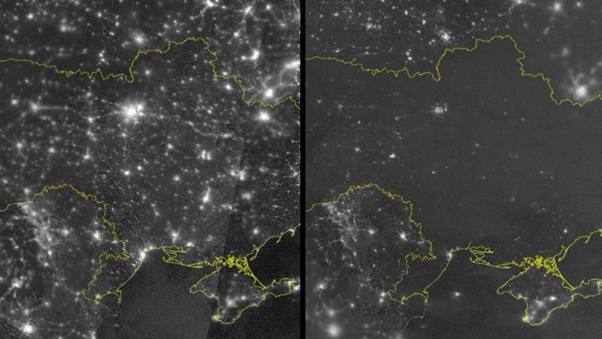
Satellite images of power usage in Ukraine in January and November of 2022, respectively.
AUTHOR: Sara. B. Gero
What has been happening in Ukraine since the start of the Russian invasion in 2022?
The invasion of Ukraine started in February of 2022 when Russian forces crossed the border from Belarus and made their way towards the capital, Kyiv. Since then, violations of international human rights and humanitarian law have been a part of the daily lives of millions of Ukrainians. However, this is nothing new for Ukrainians. Russian forces have been committing atrocities against Ukrainian civilians since the invasion of Crimea over a decade ago. They have attacked buildings used to house civilians, violated children’s right to education, and there are reports of Ukrainian prisoners of war being subject to torture and ill-treatment, including summary executions. However, this article is not about any of these atrocities, but about something that seems much more mundane at first, but affects millions of Ukrainians every day: the blackouts caused by Russian attacks on civilian infrastructure, specifically on critical energy infrastructure. Russia is using energy as a weapon against civilians.
Attacks on civilian infrastructure
Russia has been attacking Ukrainian civilian infrastructure since the beginning of the war, and it seems that they concentrate their efforts on power grids during the winter months. It was first reported by Amnesty International at the end of 2022 that, due to Russian attacks, over 40% of the country’s energy facilities had been seriously damaged. While Ukrainian authorities have attempted, and sometimes succeeded in, repairing the damaged power grids, this has proven difficult due to the constant attacks by the Russian forces on these structures, done with the purpose of undermining civilian resistance.
A recent example of such unlawful attacks occurred in October of 2025 in the city of Chernihiv, home to over 250,000 people, when the residents woke up to a complete blackout after Russian strikes on the region’s energy infrastructure. Since then, Russia has carried out several hundred intense long-distance aerial attacks against Ukraine. As a result, emergency power cuts have affected 80% of the country during a winter in which temperatures have fallen below -15 °C. To survive the freezing conditions, Ukrainians have turned to kerosene stoves to heat water bottles or bricks, for example. Others, who have gas stoves sometimes leave the stove on for hours in hopes of heating up their homes, or at least to stop the temperatures from decreasing further, but this does leave them vulnerable to serious accidents. While those with electric stoves are left with few options to heat themselves during a blackout, except to make use of any time the electricity is on or to buy an alternative heating device. At the same time, the prices of rural housing with wood or coal stoves have skyrocketed due to high demand, along with the price of said wood and coal. At the same time, those who live with disabilities, isolated in their apartments, may be experiencing conditions significantly worse than those documented. Hospitals have also been affected by the power outages, leading to suboptimal conditions, whereas they had to cancel appointments and operate with limited supplies in freezing conditions. The lack of electricity is often accompanied by a lack of running water.
The power outages also affect access to education, while many schools remain open even through power outages, the temperatures inside the classroom are often around 10 °C and meals cannot always be provided to the children throughout the day, so some parents have voluntarily switched to online classes. Of course, this is only possible if both the students and the teacher have electricity that day. There are also those who are left without any education because of the war, who similarly to urban kids cannot go to school due to the cold temperatures inside, but who also lack access to laptops or phones to attend any online classes. Sometimes this is resolved through community learning, children sharing learning exercises amongst themselves and studying independently, but these are outlier cases.
Holding Russia responsible
Currently, Russia is using energy as a weapon against civilians. By attacking civilian infrastructure, Russia is deliberately making daily life unlivable in an attempt to weaken civilian morale and pressure the Ukrainian authorities into conceding the occupied territories. It is important that this does not happen, and that Ukrainians continue to resist the Russian occupations, as it has been shown throughout recent history, the occupation of Crimea, that it is unlikely that Russia will stop after the occupation of a couple of cities.
The international community must take urgent, effective steps to support Ukraine’s humanitarian needs. Although there are active warrants for the arrest of Putin and other high-ranking Russian officials, they have evaded justice so far. Holding these officials responsible is the first step in the path to justice. Amnesty International is also committed to identifying those who commit crimes under international law and to bringing individual perpetrators to justice, not just government officials. Furthermore, reparations for everyone, including civilians, is essential.
Sources:
Amnesty International. (2026, February 13). Ukraine: “Mine is half-trouble only. . . I can ignite the gas, heat a brick, and warm myself up.” Dire humanitarian effects of the systematic Russian attacks on the energy system – Amnesty International. https://www.amnesty.org/en/documents/eur50/0686/2026/en/
Amnesty International. (2026, March 10). Ukraine: New testimonies document brutal conditions for civilians amid Russian attacks on energy infrastructure. https://www.amnesty.org/en/latest/news/2026/02/ukraine-testimonies-brutal-conditions-civilians-russian-attacks-energy-infrastructure/
Amnesty International. (2025, October 25). Russia/Ukraine: Blackout in Chernihiv exposes Russia’s unlawful attacks on civilian infrastructure. https://www.amnesty.org/en/latest/news/2025/10/russia-ukraine-blackout-in-chernihiv-exposes-russias-unlawful-attacks-on-civilian-infrastructure/
Amnesty International. (2024, November 29). Russia/Ukraine: Latest massive missile strike on critical infrastructure is a war crime. https://www.amnesty.org/en/latest/news/2024/11/russia-ukraine-latest-massive-missile-strike-on-critical-infrastructure-is-a-war-crime/
Amnesty International. (2026, January 5). Russias aggression in Ukraine – Amnesty International. https://www.amnesty.org/en/projects/russias-aggression-in-ukraine/
Amnesty International. (2024, March 18). Russia/Ukraine: 10 years of occupation of Crimea Russia is seeking to effect demographic change while suppressing Ukrainian and Crimean Tatar identities – Amnesty International. https://www.amnesty.org/en/documents/eur50/7805/2024/en/
Source image:
Remarkable photos show what blackout in Ukraine looks like from space. (2022, November 25). [Video]. CNN. https://edition.cnn.com/videos/world/2022/11/25/ukraine-blackout-doctors-surgery-flashlight-cnntm-sebastian-vpx.cnn