
AUTHOR: Charisa Thuratong
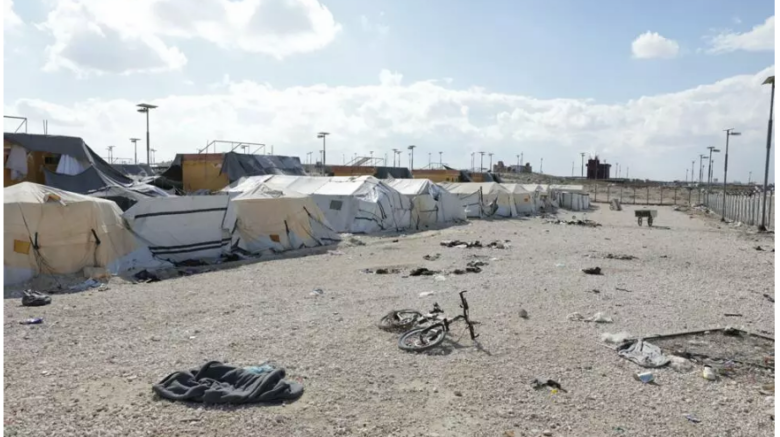
Overcrowded rooms, uncertainty over basic amenities and thin tents as a wavering roof, that is the
reality of thousands of people detained in Northeast Syria. Although the fall of the dictator Bashar
al-Assad in December 2024 brought hope to the country, many detainees still wait to break free.
Decades of Political Unrest Still Lingers Today
Syria’s political landscape is highly complex. The country is marked by decades of repression by the
Al Assad regime and the Islamic State (IS), leading to nearly 14 years of civil war and continuous
tensions with Kurdish troops. The Syrian government, Islamic State members and the Kurdish led
Syrian Democratic Forces (SDF) had resorted to mass killings, rape, arbitrary arrests and forced
recruitment. Although the camps set by the Kurdish troops in Northeast Syria were initially meant to
imprison IS fighters, now called the Islamic State of Iraq and the Levant (ISIL) fighters, or Daesh, the
Kurds’ definition of an opponent quickly broadened to any person affiliated with ISIL. This resulted
in the imprisonment of over thousands of foreigners, victims of human trafficking, and innocent
children and women.
A Lost Childhood, The Story of ISIL Children
In January 2026, the UN reported over 30,000 people from Iraq, Syria, Australia, the United Kingdom
and more being detained in the Al-Hol camp. According to an article dating back to September 2025,
60% of the overall population are “mainly under the age of 12.” Yet, any entrance to detention camps
remains limited with strict monitoring by the SDF and the Autonomous Administration of North and
East Syria (AANES). Therefore, children have restricted access to basic essentials and grow up
without formal education, which not only violates article 26 of the Universal Declaration of Human
Rights but also prevents the children’s integration into society, an essential step toward a country’s
stability and development.
Alexandre Zouev, UN’s Acting Under-Secretary-General for Counter-Terrorism, fears those camps
might be “potential incubators of radicalisation”. With children growing up with strong
stigmatisations around Kurds, radical tendencies might emerge, leading to a never ending cycle of
violence. Beyond stigmatisations, the UN reported that “hundreds of adolescent boys have been
forcibly separated from their mothers and are held in prisons or rehabilitation centres.” This sudden
separation at puberty is a significant source of distress, and such an abrupt displacement also nurtures
feelings of revenge which are exacerbated by male ISIL affiliates to mass recruit young boys. While
ISIL represents a threat to the stability of the region, those detention camps are the living proof that
arbitrary arrests and prolonged detentions are ineffective at containing radicalism.
Another major concern is the children’s health. With thousands of people strained in a small space,
civilians are exposed to “influenza-like illnesses and severe acute respiratory infections” declared the
UN’s health partners in an article published in February 2025. Although during that same period the
UN managed to provide heaters, winter clothes and other aid to the children, uncertainties over
funding last year raise alarming concerns over their conditions this year as well. Indeed, “less than
10% of the $1,2 billion needed has been received” in 2025 to help civilians through the harsh winter
in Syria. This year, at least 5 children died in Ain Al Arab (the north of Syria) at the beginning of
2026 due to the lack of health services and winter supplies. Such neglect of the youth is a ringing
alarm for the Syrian government and Kurdish troops to pursue peace dialogues for the sake of
civilians’ safety and the country’s future.
The Unescapable Cycle of Gender-Based Violence on Women
Since the beginning of hostilities between the armed forces in 2014 to today, gender-based violence
against women persists. In an Amnesty report on detention camps in Northeast Syria in 2024,
countless testimonies of torture, sexual exploitation and abuse perpetrated by ISIL affiliates and
security forces were collected.
According to a report from UN Women in 2025, “32 out of 53 women married between 2014 and
2019 were aged 13-17”. Indeed, before their arrival in detention camps, most girls were trafficked in
guesthouses, also called “madafa”, to be coerced into marriage with ISIL members. As there were
incentives to favour those unions, being married to an ISIL member would guarantee financial
stability and protection to the girl and to her family by extension. But in reality, the union only sealed
a life of abuse with no way out. The death of the husband would by no means lead to freedom: if a
woman was widowed, she would be forced to marry another ISIL member.
Despite the separation from abusive husbands within their entrance in detention camps, mistreatment
of women continues inside Al-Hol. In the 2024 Amnesty report on the conditions in Al-Hol and
Al-Roj, a representative of YPJ Military Intelligence – the Kurdish People’s Protection Unit –
informed Amnesty International that women who were less radical or tired of the Islamic State were
targeted by people acting in the name of ISIL. This group of affiliates would particularly target
pregnant women and physically abuse them, sometimes to death, due to their pregnancy being a sign
of sex outside marriage and of morality crime: “There were Indonesian and Azerbaijani women
who were pregnant and were killed by lashing to death.”
In addition to peer pressure, violence and sexual assaults from security forces, market vendors and
NGO workers are part of women’s daily life. As the economy in Al-Hol and other means of survival
are highly controlled and often exploitative, cases where perpetrators abuse their power by asking
women for “relationships” in exchange for services became common. On the other hand, those who
sought to work needed permission from their male relatives or “faced threats, harassment, or violence – including tent burnings and death threats”, further deterring women from gaining independence and
pushing them deeper into poverty.
On a Tedious Path Toward Political Stability
Despite efforts to ease hostilities between the Syrian government and the SDF, ceasefires remain
fragile. Indeed, escalations occurred between the armed forces in December 2025 and January 2026 in
Aleppo city, causing at least five deaths and “some 30,000 people displaced” according to the UN
News. Following this incident, President Ahmed al-Sharaa issued Decree No. 13 on linguistic,
cultural and citizen rights for Kurds in order to pave the way for diplomatic talks with the SDF and
AANES.
A ceasefire was finally agreed on January 30th with a deal providing a “phased military
administrative integration of northeast Syria and provisions on the return of displaced people”. So far,
Claudio Cordone, the UN’s Special Envoy to Syria, declared that the implementation of this plan “has
been progressing in a positive manner” and the situation in northeast Syria seems to have stabilised.
On the other hand, the fate of civilians in detention camps remains unsure but further efforts to
maintain the ceasefire could accelerate the repatriation process. During the High-Level International
Conference hosted by the Republic of Iraq and supported by the UN Office of Counter-Terrorism
(UNOCT) in September 2025, the Republic of Iraq assessed that it had repatriated “17,100
individuals” by the time of the conference. Concerned states were encouraged to pursue this effort as
well to ensure the safety and rehabilitation of their nationals.
With recent escalations across the Middle East, a wave of uncertainty stirs Syria’s progress toward a
political transition. Indeed, Israel’s helicopters and drone operations have significantly increased in
Syria’s airspace since the beginning of tensions with Iran. However, Israeli incursions in Syrian
territory are a direct violation of the 1974 Disengagement of Forces Agreement. Claudio Cardone
calls on Israel to “fully respect Syria’s sovereignty and territorial integrity” and to “redouble efforts to
support Syria in shielding itself from this conflict.”
References:
Amnesty International. (2024, April 17). Syria: Aftermath: Injustice, torture and death in detention in
north-east Syria. Amnesty International. https://www.amnesty.org/en/documents/MDE24/7752/2024/en/
Amnesty International. (2024, July 31). Syria: Mass death, torture and other violations against people
detained in aftermath of Islamic State defeat. Amnesty International. https://www.amnesty.org/en/latest/news/2024/04/syria-mass-death-torture-and-other-violations-agains
t-people-detained-in-aftermath-of-islamic-state-defeat-new-report/
Amnesty International UK. (2026, January 13). Syria: tens of thousands marooned in detention camps
and facilities where death, torture and disease are rife. https://www.amnesty.org.uk/latest/syria-tens-thousands-marooned-detention-camps-and-facilities-where-death-torture-and/
Amnesty International. (2026, March 5). Syria: Human rights and international law must guide next
steps in north-east Syria. https://www.amnesty.org/en/latest/news/2026/01/syria-human-rights-and-international-law-must-guide-next-steps-in-north-east-syria
Edouard Begbeder. (2026, February 6). 2026 brings no respite to children living in violence and
conflict in the Middle East and North Africa. UNICEF. https://www.unicef.org/mena/press-releases/2026-brings-no-respite-children-living-violence-and-conflict-middle-east-and-north
High-Level International Conference on the Repatriation of Persons from Al Hol, Surrounding Camps
and Places of Detention. (n.d.). Office of Counter-Terrorism. https://www.un.org/counterterrorism/en/events/high-level-international-conference-repatriation-perso ns-al-hol-surrounding-camps-and-places
Middle East war risks undermining Syria’s fragile recovery, Security Council hears | The United
Nations Office at Geneva. (2026, March 11). The United Nations Office at Geneva.
https://www.ungeneva.org/en/news-media/news/2026/03/116903/middle-east-war-risks-undermining
syrias-fragile-recovery-security
OHCHR. (2025, April 7). UN experts urge end to ISIL-related arbitrary detention in North-East Syria
and accountability for international crimes. https://www.ohchr.org/en/press-releases/2025/04/un-experts-urge-end-isil-related-arbitrary-detentionnorth-east-syria-and
UN warns time running out for families with terrorist ties stranded in Syria camps. (2025, September
26). UN News. https://news.un.org/en/story/2025/09/1165966
Ibrahim Olabi (Syrian Arab Republic) on the situation in Syria – Security Council Media Stakeout.
(2026, January 20). [Video]. UN News. https://news.un.org/en/story/2026/01/1166799
Syria: Aleppo fighting leaves civilians dead, displaces thousands | The United Nations Office at
Geneva. (2026, January 11). The United Nations Office at Geneva. https://www.ungeneva.org/en/news-media/news/2026/01/114619/syria-aleppo-fighting-leaves-civilians-dead-displaces-thousands
Syria: Thousands of displaced head home, but many refugees still wary. (2025, February 13). UN
News. https://news.un.org/en/story/2025/02/1160126
Syria: Aleppo fighting leaves civilians dead, displaces thousands | The United Nations Office at
Geneva. (2026, January 11). The United Nations Office at Geneva. https://www.ungeneva.org/en/news-media/news/2026/01/114619/syria-aleppo-fighting-leaves-civilians-dead-displaces-thousands
Vibhu Mishra. (2026, January 22). Syria: Renewed clashes risk derailing fragile transition. UN News.
https://news.un.org/en/story/2026/01/1166811
Vibhu Mishra. (2026, February 14). Syria transition gains ground with Kurdish deal, but violence and
humanitarian strain persist. UN News. https://news.un.org/en/story/2026/02/1166961
UN Women. (2025, October). Understanding the lives of the women, men and children of Al-Hol
camp. UN Women. https://www.unwomen.org/sites/default/files/2025-10/Understanding-the-lives-of-the-women-men-and-children-of-Al-Hol-camp-Executive-summary-en.pdf
Image:
France. (2026, February 26). Dans le camp de proches de jihadistes d’al-Hol en Syrie, le “chaos
total.” France 24. https://www.france24.com/fr/info-en-continu/20260226-dans-le-camp-de-proches-de-jihadistes-d-al-hol-en-syrie-le-chaos-total