AUTHOR: Lorena Hutanu
The year 2025 marks a devastating setback for global human rights. At least 2,707 executions were recorded across 17 countries, representing a 78% increase compared to 2024. This is the highest figure recorded by Amnesty International since 1981. Shockingly, this data excludes the thousands of executions that are happening hidden behind state secrecy, led by the world’s leading executioner, China, as well as other known adepts of the death penalty, such as Vietnam or North Korea. This global increase is alarming; countries are resuming their use of the death penalty after years of non-use, with the most important escalation in the Middle East.
A Regional Crisis
The Middle East and North Africa (MENA) are at the center of this human rights crisis. Total executions in the region grew from at least 1,442 in 2024 to at least 2,611 in 2025. While Iranian authorities have the highest figure with 2,159 executions, other countries are quickly following suit. Seven countries across the region have carried out executions in the past year: Egypt, Iran, Iraq, Kuwait, Saudi Arabia, the UAE, and Yemen. Saudi Arabia reached its own high with at least 356 executions, and the UAE has resumed executions for the first time since 2021. Kuwait went from 6 executions in 2024 to 17, almost tripling its number, and in Egypt, they almost doubled it from 13 to 23. In Yemen, going from 38 to at least 51.
What makes this visible trend horrifying is the clear violation of international human rights law. Amnesty International describes the death penalty as “a violation of the right to life, and it is the ultimate cruel, inhuman and degrading punishment”. Furthermore, under international law, capital punishment must be strictly limited to the “most serious crimes” such as intentional killing.
However, this is not the case currently in the Middle East and North Africa. Up to 46% of all recorded executions in 2025 (1,257) were for drug-related offenses (non-lethal). For example, in Saudi Arabia, 67% of their executions were for drug-related charges, and in Iran, 998 executions were for similar offenses.
The Escalation
The increase in executions in Iran did not happen overnight; it’s a result of a multi-year escalation organized by the state. While execution counts were already a concern in the previous years, Iranian authorities seem to have doubled down on their most severe punishments to preserve their political stance. Since 2021, their lethal punishments have kept increasing to maintain their government, using fear and death to push their citizens into silence and conformity.
The War on Drugs Pretext
The Iranian authorities have long used pretexts to legitimize their bloodshed, the most widespread one being the “War on Drugs”. In 2023, they convicted 173 people of drug-related offences after systematic, unfair trials. These executions were already triple from what they were in 2022, but today, in 2025, a shocking 998 executions for drug-related offences were carried out.
These executions are often the outcome of Iran’s anti-narcotics police and other security bodies’ flawed investigations. Detainees are denied due process rights, such as having legal representation. Additionally, they are forced to “confess” their crimes under torture to be used as evidence to convict them. This shows a blatant violation of international law.
Furthermore, these executions, on top of representing a large number of all executions, are unfair and target specifically people from marginalized and economically disadvantaged backgrounds. Such as the Baluchi ethnic minority that is targeted and persecuted by the authorities, making for 20% of the recorded executions while only making up 5% of Iran’s population. Kurdish minorities or individuals with Afghan nationality are also often targeted using drug charges as a cover for systemic discrimination.
The War on Women and Girls
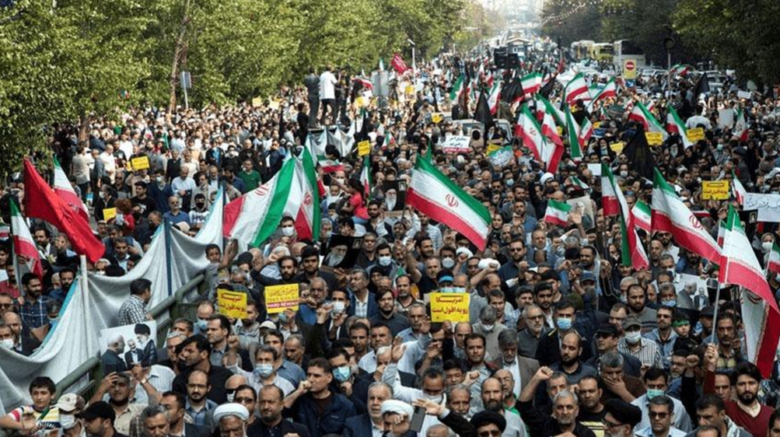
As the Iranian government keeps on increasing its use of executions based on unlawful evidence, the Women’s Life Freedom uprising protests of 2022 have brought forth a new opponent to their political ideas. The state launched a war on women, specifically against those who defied compulsory veiling laws. In an effort to stop the movement, the authorities initiated the “Noor Plan”, a campaign based on violence such as car chases, confiscations, imprisonment, and torture.
The death penalty was the next step to further oppress the population; unfair trials were served to individuals in relation to the protests. A tragic example is Reza Rasaei, a 34-year-old human rights activist from Iran’s oppressed Kurdish minority. Arrested during the 2022 protests, he suffered severe torture, electric shocks, and sexual violence. In 2024, he became the tenth person executed in connection with the uprising. He was executed in total secrecy, without prior notice to his lawyer or family. Furthermore, his family was forced to bury him in a remote area surrounded by security forces to prevent proper mourning. Three years later, the state continues to attack human rights defenders, activists, and humanitarian workers who are fighting for women’s rights.
Current Status
In 2026, Iranian authorities have stopped any act of judicial fairness and are doubling down on fabricated charges, aggressive attacks and eliminations of any political opposition. Since the latest regional hostilities in February, the regime has already executed 36 individuals on politically motivated charges. Currently, at least 78 protesters and dissidents are on death row and at imminent risk of execution. This includes children at the time of their alleged offenses. By classifying peaceful manifestations as ‘espionage’, ‘enmity against God ‘, ‘corruption on earth’, or even ‘armed rebellion against the state’, despite the peaceful nature of the protests. The state continues to silence the population and prevent them from standing up against their tyranny.
A Call for Action
Despite the increase in these terrifying killings in Iran, the global trajectory still tends towards justice, with 113 countries having fully abolished the death penalty for all crimes. Amnesty International unconditionally opposes the use of capital punishment, recognizing it as a cruel punishment and is actively calling for action and the liberation of current prisoners unfairly arrested who are facing possible death.
Sources:
Amnesty International. (2023, January 26). Iran: Chilling use of the death penalty to further brutally quell popular uprising. https://www.amnesty.org/en/latest/news/2022/11/iranchilling-use-of-the-death-penalty-to-further-brutally-quell-popular-uprising/
Amnesty International. (2024a, December 10). Iran: Two years after ‘Woman Life Freedom’ uprising, impunity for crimes reigns supreme. https://www.amnesty.org/en/latest/news/2024/09/iran-two-years-after-woman-lifefreedom-uprising-impunity-for-crimes-reigns-supreme/
Amnesty International. (2024b, December 11). Iran: Prisons turned into killing fields as drugrelated executions almost triple this year. https://www.amnesty.org/en/latest/news/2023/06/iran-prisons-turned-into-killing-fieldsas-drug-related-executions-almost-triple-this-year/
Amnesty International. (2026a, May 17). GLOBAL: Executions surge to highest recorded figure in 44 years. Amnesty International. https://www.amnesty.org/en/latest/news/2026/05/executions-surge-highest-recordedfigure-44-years/
Amnesty International. (2026b, May 18). Death penalty in 2025 – Facts and figures. https://www.amnesty.org/en/latest/news/2026/05/death-penalty-in-2025-facts-andfigures/
Amnesty International. (2026c, May 18). Death sentences and executions 2025 – Amnesty International. https://www.amnesty.org/en/documents/act50/0778/2026/en/
Amnesty International. (2026d, May 22). Iran: Further Information: Protesters and dissidents at risk of execution – Amnesty International. https://www.amnesty.org/en/documents/mde13/1032/2026/en/
GLOBAL: Executions surge to highest recorded figure in 44 years. (2026, May 18). Amnesty International Thailand. https://www.amnesty.or.th/en/news/2026/05/global-executionssurge-to-highest-recorded-figure-in-44-years/
Source image:
Reuters. (2022, November 3). Demonstrations in Iran entered their seventh week [Photograph]. Al Jazeera. https://www.aljazeera.net/news/2022/11/3/%D8%A7%D8%AC%D8%AA%D9%85%D8%A7% D8%B9-%D8%BA%D9%8A%D8%B1 %D8%B1%D8%B3%D9%85%D9%8A%D9%81%D9%8A-%D9%85%D8%AC%D9%84%D8%B3%D8%A7%D9%84%D8%A3%D9%85%D9%86-%D9%84%D8%A8%D8%AD%D8%AB