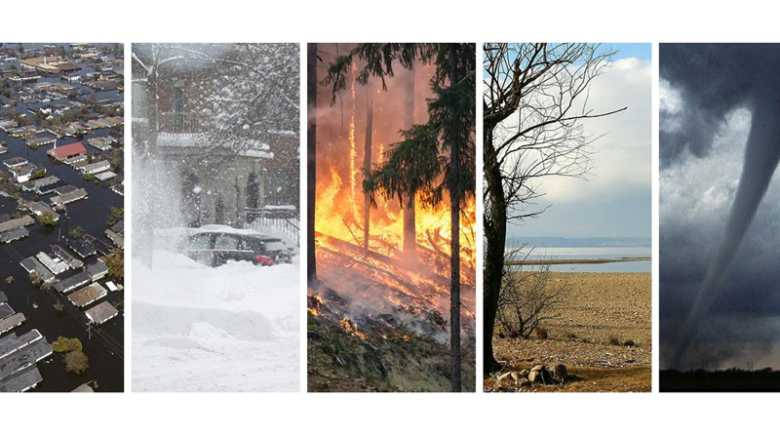
Some of the effects of climate change depicted in an article by the US National Centers for Environmental Effects
AUTHOR: Sara B. Gero
Climate change increases the risks of extreme weather events, including droughts, floods and wildfires, making them more unpredictable and intense. At the same time, climate change exacerbates food insecurity. Rising sea levels, droughts and the changes in rainfall patterns can destroy crops and kill livestock. For vulnerable communities around the world, this could mean the difference between survival or death. To make matters even worse, competition over depleted natural resources can spark conflict between communities, as has been seen throughout history. It is imperative that we recognize that climate change is already causing problems that can no longer be ignored. It is coming at the cost of not only environmental degradation, but also human lives.
How does climate change impact refugees who have already been displaced?
Many refugee centers are located in areas prone to the effects of climate change and natural disasters, which places them at risk of secondary displacement. In the Sahel Region of West Africa, one of the world’s fastest growing displacement crises is taking place, and at the same time, temperatures are rising 1.5 times faster than the global average. This not only changes weather patterns, but also poses a direct threat to their health and well-being. This is not an isolated example. The number of countries projected to face the extreme consequences of climate change is expected to increase from 3 to 65 by 2040. Together, these countries host more than 40% of all currently displaced people.
How does climate change affect the number of displaced people?
By mid-2025, 117 million people had been displaced by war, violence and persecution. ¾ of them live in countries facing high or extreme exposure to hazards caused by climate change. Between 2015 and 2025, weather-related disasters have caused around 250 million internal displacements, amounting to around 70,000 displacements per day. This is expected to increase significantly as the effects of climate change become more severe, potentially leading to the displacement of hundreds of millions of people.
Environmental, or climate, refugees according to the law
The terms “climate refugee” or “environmental refugee” do not exist in international law, which only defines the term “refugee”. Accordingly, a refugee is a person who has a “wellfounded fear” of persecution in their country for reasons of race, religion, nationality, membership of a particular social group, or political opinion, and therefore they cannot be returned to their country. International law does not distinguish between different categories of refugees, as doing so could undermine existing protections and cause more harm than good.
It is difficult to obtain refugee status in the context of climate change. To do so usually requires resources like food, housing or clean water to be scarce and for already marginalized groups to be denied access to these scarce resources. Members of these marginalized groups may obtain refugee status under the 1951 Refugee Convention due to risk of persecution. It has not always been obvious that people displaced in the context of climate change are included in this Convention. Furthermore, only some countries offer dedicated protections against returns to other countries due to risks of human rights harm, caused by climate change.
What can we do?
We must hold decision makers to their legal responsibility to protect people displaced in the context of climate change. All States must establish clear legal frameworks at national, regional and international levels for people displaced due to climate change. At the same time, States must act against climate change, so that the risks do not worsen. This includes reducing carbon emissions, by, for example, phasing out fossil fuel subsidies, as well as helping people adapt to the effects of climate change, and providing compensation to those displaced due to these effects.
Sources:
Amnesty International. (2021, October 11). What has climate change got to do with human rights? https://www.amnesty.org/en/latest/campaigns/2015/12/climate-changehuman-rights/
Amnesty International. (2025, June 17). ‘We were only asking for our rights’: Tunisian authorities punish mobilization for socioeconomic and environmental rights.
https://www.amnesty.org/en/latest/news/2025/06/we-were-only-asking-for-our-rightstunisian-authorities-punish-mobilization-for-socioeconomic-and-environmentalrights/
Amnesty International. (2025, October 9). When people are displaced by climate change, what rights do they have?
https://www.amnesty.org/en/latest/campaigns/2025/10/when-people-are-displaced-byclimate-change-what-rights-do-they-have/
How climate change impacts refugees and displaced communities. (2026, April 22). https://www.unrefugees.org/news/how-climate-change-impacts-refugees-anddisplaced-communities/
Source for the picture:
Calculating the cost of weather and climate disasters. (2025, February 28). National Centers for Environmental Information (NCEI). https://www.ncei.noaa.gov/news/calculating-cost-weather-and-climate-disasters