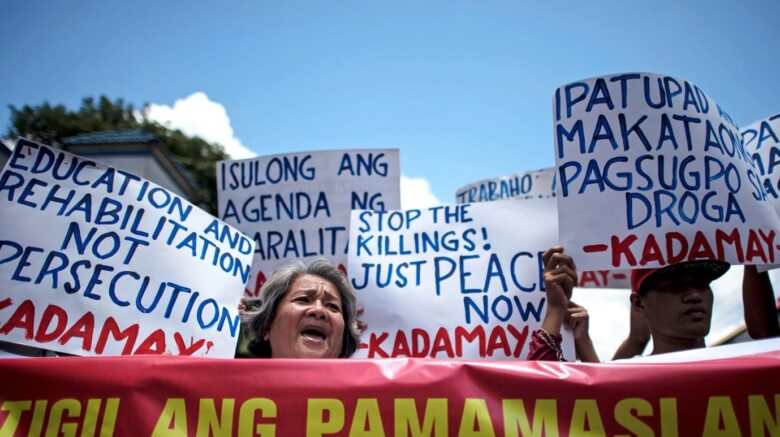
Source: The New Yorker
AUTHOR: Sibila del Palacio Cuesta
“This trial is not about politics. It is about the thousands of people that were killed in cold blood”
With these words, the International Criminal Court opened its investigation into one of the most violent chapters in recent Philippine history. The trial of former Philippines president Rodrigo Duterte has resurfaced the violence that occurred during the war on drugs in the country. The ex-president wasarrested on 11th March 2025 on an ICC warrant for crimes against humanity.
On 23 April 2026, the Pre-Trial Chamber confirmed all charges, therefore committing him to trial.
The ICC has been carrying out investigations in relation to the “war on drugs” under his presidential administration, as well as those in Davao City during his time as mayor from 2011 to 2016.
Background
Between July 2016 and May 2019, approximately 6,600 people, officially labelled “drug personalities” were killed under Duterte’s anti-drug campaign. According to the ICC prosecution, the killings were carried out by a “National Network” comprising law enforcement personnel, non-police assets, and hitmen operating under their direction. The stated aim was to “neutralise” those suspected of involvement in drug-related activity. In practice, neutralise meant murder, committed as part of a systematic campaign of violence directed at poor and marginalized communities. Amnesty International has condemned the act as a “lethal policy”.
As reported in an investigation published in January 2017 by Amnesty International, “mostly poor and defenceless people” were targeted across the country. A pattern also seemed to appear within the victims; evidence was planted on victims, paid killers were recruited, belongings were stolen, and official incident reports were fabricated. The reports in fact, “looked like templates” as Jasmin Navarro-Regino, the head of the Commission on Human Rights’ regional office (whose territory includes Bulacan) stated, following with a concerning reality “I memorised it already”.
Further, Dr. Raquel Fortun, a forensic pathologist who has conducted multiple independent autopsies on victims, reinforced the argument. “It’s so consistent, it’s a script. In fact, when you see the report, it looks like a template… and they just change the dates, the names…And the cases I see and the others I have not, they sustain multiple gunshot wounds, clearly more than enough to subdue, to disable … So, what are you talking about in terms of you shot them because they fought back?” The latter referring to Duterte’s form of justification on murder.
In one documented case, Jovan Magtanong, a 30-year-old father of three, was shot dead by police who claimed he had fired at them first. Witnesses said he was asleep beside his children when officers arrived at his door asking for someone else. Importantly, his family said they did not own a gun, and that the victim had not used drugs in over a year. “They killed him like an animal” a family member told Amnesty International.
A system of so-called “drug watch lists” was being compiled, where local officials were pressured to produce names. These watch lists were essentially being used as kill lists, functioning outside legality. Once listed, there was no way to be removed, creating not only a system of perpetual surveillance, but an atmosphere of fear within targeted communities. “It is not safe to be poor in President Duterte’s Philippines” said Nicholas Bequelin of Amnesty International. “All it takes to be murdered is an unproven accusation that someone uses, buys, or sells drugs”.
Ordinary people were terrified.
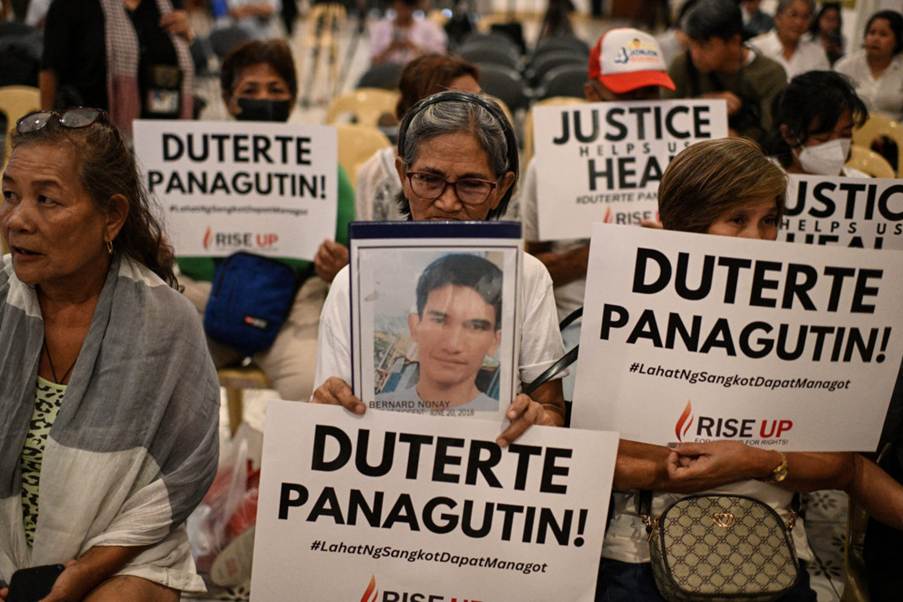
War on drugs family victims before the start of former Philippine President Rodrigo Duterte’s hearing on the confirmation of charges on his alleged crimes against humanity case at the International Criminal Court. (February 23, 2026). Source: PBS NEWS
ICC’s Jurisdiction
In 2018, the Philippines gave a notice of withdrawal from the ICC, which was processed on17 March 2019. The country had been a member since 1 November 2011. As the crimes examined occurred while it was a member, the ICC retains its jurisdiction.
Impunity
Before Duterte’s prosecution, impunity was the norm, and justice seemed like an impossibility. Distrust in authorities, left victims feeling as if they had nowhere to turn, “Lawyers and experts repeatedly expressed concern over how police were responsible for investigating themselves”. With no foreseeable domestic accountability, many were putting their hopes in the International Criminal Court or the United Nations as a final resort. The Philippine’s withdrawal from the ICC after the institution’s announcement of a “preliminary examination” was yet another attempt to evade accountability.
Under this context, the arrest of Rodrigo Duterte should be seen as a first step into the accountability deserved by all the victims and their families.
What once was considered impossible is now occurring, and for the thousands of people “killed in cold blood” this is where justice begins.
Reference List:
Amnesty International. (2019). Philippines: ‘They just kill’. Ongoing extrajudicial executions and other violations in the Philippines’ ‘war on drugs’ (Index No. ASA 35/0578/2019). https://www.amnesty.org/en/documents/asa35/0578/2019/en/
Amnesty International. (2025, March 11). Philippines: Former president Duterte’s arrest a monumental step for justice. https://www.amnesty.org/en/latest/news/2025/03/philippines-former-president-dutertes-arrest-a-monumental-step-for-justice/
Amnesty International. (2025, September 24). ‘I have no reason to stay silent’ – relative of ‘war on drugs’ victim tells of fight for justice. https://www.amnesty.org/en/latest/campaigns/2025/09/i-have-no-reason-to-stay-silent-relative-of-war-on-drugs-victim-tells-of-fight-for-justice/
Amnesty International. (2026, April). Philippines: Confirmation of Duterte trial offers victims prospect of long-awaited truth and justice. https://www.amnesty.org/en/latest/news/2026/04/philippines-confirmation-of-duterte-trial-offers-victims-prospect-of-long-awaited-truth-and-justice/
International Criminal Court. (2026, April 23). ICC Pre-Trial Chamber I confirms all
charges against Rodrigo Roa Duterte and commits him to trial. https://www.icc-cpi.int/news/icc-pre-trial-chamber-i-confirms-all-charges-against-rodrigo-roa-duterte-and-commits-him-trial