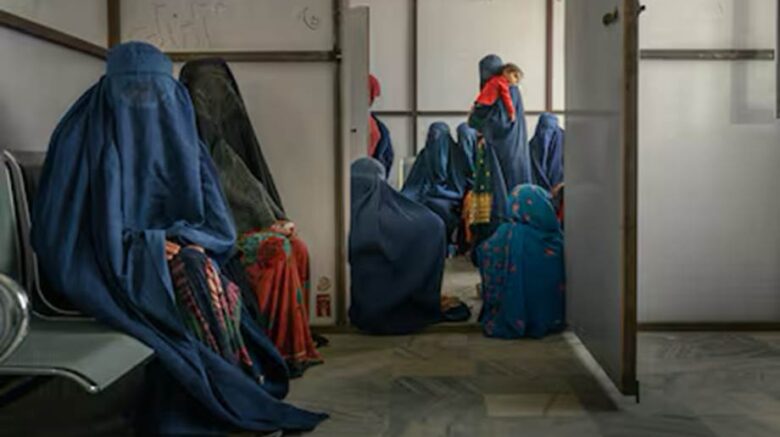
Women wait in a hospital in Ghazni, August 2025 (EL PAIS)
AUTHOR: Sibila del Palacio Cuesta
In the five years since the Taliban reclaimed power over Afghanistan in August 2021, a systematic rewriting of legislation has been underway. Corporal punishment has gone hand in hand with this new legislative reality. In 2025 alone, more men and women were subjected to public flogging than in all previous years combined since the Taliban’s return to power. Early indications in 2026 suggest the rate of such punishments may continue to escalate.
Afghanistan’s de facto Supreme Court announced the public flogging of at least 1,110 individuals in 2025, including 940 men and 170 women. In January 2026 alone, 147 men and 15 women were publicly flogged, one of the highest monthly totals since the practice was formally introduced in late 2022. The floggings include commonly 39 lashes and are carried out in public by Taliban officials. Residents, including children, are compelled to attend.
While the majority enduring the floggings have been men, accused of crimes such as theft or gambling, women, girls and LGBT+ people face a distinct vulnerability. The latter are punished not for what are considered as ‘recognised crimes’ but for ‘moral offences’ such as adultery, illicit relationships, and sodomy. In this sense, the corporal punishment for such ‘crimes’ reflects the system of institutionalised gender-based discrimination within Afghanistan’s society.
As a UN Special Rapporteur establishes, corporal punishment is an offence against human dignity and physical integrity and, depending on its severity, would amount to cruel, inhuman or degrading punishment and/or torture. “It should be halted immediately”.
Yet it has not. Recently, a new regulation has formalised this institutional ‘horror’. The Criminal Procedure Regulation of the Courts, signed by Supreme Leader Hibatullah Akhundzada in January 2026 and immediately circulated within courts across the country for implementation, renders several critical rights exponentially more vulnerable.
How are women directly affected with this new change of legislation?
While women in Afghanistan have already been completely sidelined from society. This regulation transcends women’s right’s within society to those in their own household. It normalizes violence while failing to criminalize it.
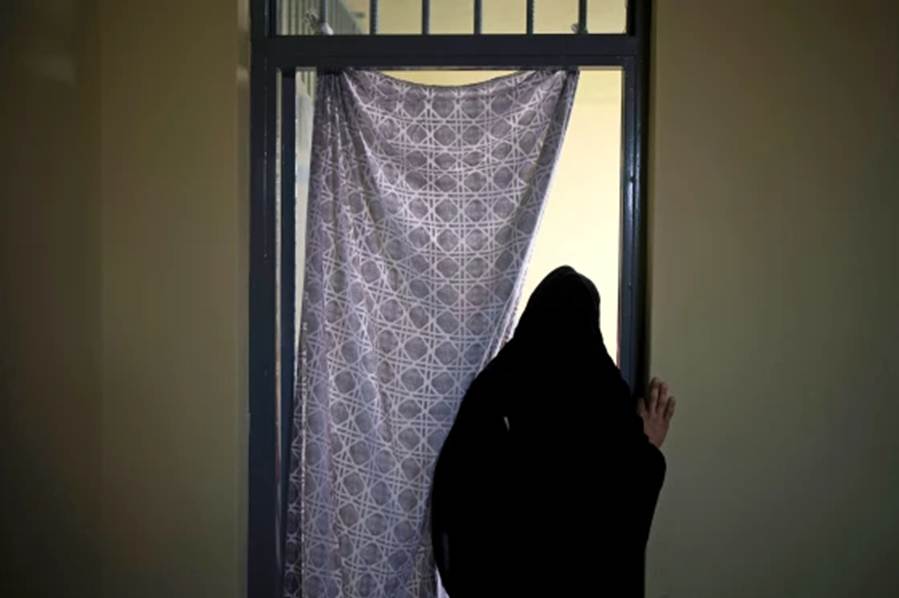
An Afghan woman at a prison in Kabul in 2021 (Felipe Dana / AP)
Article 32 for instance, prescribes only 15 days of imprisonment for a husband who physically abuses his wife, and only in the case that the abuse results in a broken bone, an open wound, or bruising visible on her body. This is a strict legal loophole for men to abuse their wives, and not only to do it, to normalize it. Further, leaving no space for sexual, psychological or other types of violence to even be prosecuted. Legally speaking, they do not exist.
Article 4, Clause 5, goes further still. It grants a husband the explicit legal right to carry out ‘discretionary’ (tazir) punishment on his wife. Placing authoritative power in the man to punish within what is supposed to be her ‘safe space’. Does this turn a women’s household into a formal prison? When the lines between prison and your home become blurred, what recourse remains? Tazir punishments are not fixed by the Qur’an or Hadith, meaning no limit is written. An undefined form of punishment functions as a feature granting maximum power to men, and not as a legal oversight.
When a woman seeks to leave her oppressive household, Article 34 closes that exit too. It criminalizes a woman who seeks refuge at her family’s home without her husband’s permission, prescribing up to three months of imprisonment. It further criminalizes any family member who shelters her. Article 34 removes the only place of refugee women had left in Afghanistan.
These regulations do not simply seek to isolate women; it seeks to normalize this isolation and make everyone active participants within women’s oppression.
The new codifications in the regulation fall outside legal recognition. They directly violate the Convention on the Elimination of All Forms of Discrimination Against Women (CEDAW), including protections against gender-based violence, the right to bodily autonomy, and the guarantee of equality within marriage and family life. Afghanistan is bound by these obligations since 2003.
This is not law; it is systematic oppression written down and further institutionalized across the country.
International silence and neutrality carry out the legitimization of a system that has made violence not only permissible, but legal.
Reference List
Amnesty International. (2026, March 6). Afghanistan: The Taliban must immediately revoke the criminal procedure regulation of the courts (ASA 11/0782/2026). https://www.amnesty.org/en/documents/asa11/0782/2026/en/
Amnesty International. (2026, March 6). Afghanistan: New criminal regulation targets women and minority groups with ever-harsher punishments. https://www.amnesty.org/en/latest/news/2026/03/afghanistan-new-criminal-regulation-targets-women-and-minority-groups-with-ever-harsher-punishments/
Bennett, R., et al. (2026, March 3). Afghanistan: UN experts condemn Taliban’s surging use of corporal punishment. United Nations Office of the High Commissioner for Human Rights. https://www.ohchr.org/en/press-releases/2026/03/afghanistan-un-experts-condemn-talibans-surging-use-corporal-punishment