
AUTHOR: Charisa Thuratong
The race for critical minerals in Myanmar by both external and internal forces may hinder attempts to bring stability and safety to the population. Rare earth elements are the new coveted resources for the green transition and the defence industry, yet the exploitation of those minerals is deeply detrimental for civilians and the environment.
The irony of the green transition
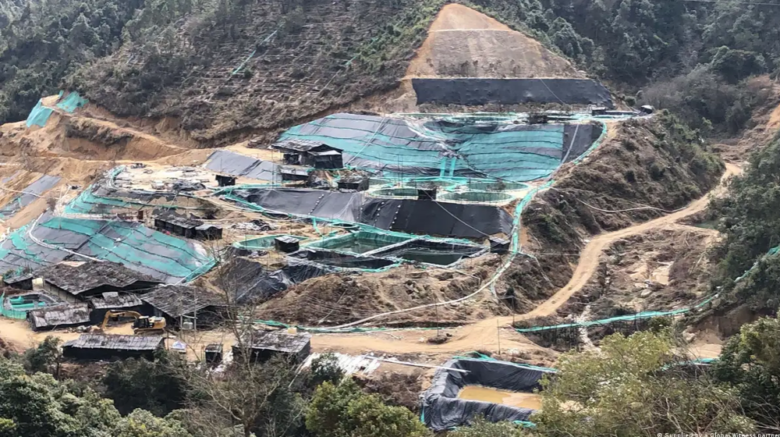
Wind turbines, solar panels and electric vehicles are among the considered solutions for the green transition but their components have an environmental cost. The production and functioning of those machines require rare earth elements, minerals that demand an intensive extraction process involving bulldozing forests, and an enormous amount of water and energy to sort those metals from the dirt. In Myanmar, China has had a monopoly over those resources in the Kachin region since 2015 but there has never been clear environmental regulations nor monitoring of the mining sites.
Local farmers are particularly in a precarious situation right now. With their lands taken away in favour of mining, the agricultural sector is weakened and limited access to fertilizers due to the Hormuz blockade represents a major threat to food security. The poisoning of the soil, air and water sources has already made crops and livestock hard to sell and export, so the overlapping of the poison and the crisis deepens farmers’ distress.
In parallel, civilians are also exposed to those chemicals, therefore to respiratory illnesses, miscarriages, skin diseases and more, consequently stunting the growth of children. This issue does not stop at the borders of Kachin, it also spreads to neighbouring countries, notably Thailand, through the contamination of the Mekong river.
While the UN pushes for sustainable development goals to be met and the EU ambitions to reach its Green Deal’s objectives, those targets create an increasing demand for rare earth minerals despite weak regulations on ethical resourcing. Even though the EU and the U.S.’ race for those reserves may not put a direct pressure on Myanmar yet, the speed at which AI has been integrated into our daily life and its growing use in the defence industry may turn the country into a playground for foreign powers in the near future.
Gloomy prospects for civilians
Since April 3rd, Min Aung Hlaing, the former Head of Myanmar’s Armed Forces and leader of the 2021 coup d’Etat, has been the president of Myanmar. His arrival to power means a continued oppression against civilians with no prospects of pacifying tensions with regional armed groups.
Charged for crimes against humanity by the International Criminal Court, Min Aung Hlaing appeared in Amnesty’s 2018 report for actively participating in the Rohingya genocide in the Rakhine State. Following the 2021 coup, he proceeded to carry out mass arbitrary arrests, raids and unlawful air strikes that have killed 7,000 civilians and destroyed hospitals, schools, displaced camps and many other public infrastructures.
Backed by a predominant pro-junta parliament, as well as Russia and China, regulations regarding rare earth exploitation may loosen further. This would enable Aung Hlaing’s biggest sponsors to have easy access to free resources for the development of their defence industry in return of unlimited weapon supplies for Myanmar’s military, further threatening the safety of civilians and any opposition to the regime.
Pressure on the junta must continue
Arrest warrants against Min Aung Hlaing must take effect and International Criminal Court members have the duty to deny his entrance into their territory and arrest him if he steps outside of Myanmar. On the other hand, putting in place isolationist measures will not break the cycle of violence against the population. Humanitarian aid must continue to be delivered to prevent mass starvation and mitigate symptoms caused by rare earth extraction, while sanctions against the junta must continue to prevent the acquisition of more weapons that could fuel internal tensions between the military and armed groups.
Parallelly, efforts to maintain dialogue with the Association of Southeast Asian Nations (ASEAN) have to pursue, and the five-point-consensus implemented:
● Immediate end to violence in the country
● Dialogue among all parties
● The appointment of a special envoy
● Authorisation of humanitarian assistance by ASEAN
● Permission for the ASEAN’s envoy to visit Myanmar and meet all parties
With rare earth elements playing a growing role in technological innovation, including the green transition and the defence sector, demands are growing and so are the stakes around those minerals. China continues to deepen its grip on Myanmar’s resources through informal arrangements with local armed groups, while India has begun exploring its own access to Kachin’s deposits. Ironically, none of these arrangements, whether formal or otherwise, include defined rules on environmental or worker safety.
Building a sustainable future for one country cannot be done at the detriment of another. Strict regulations on ethical supply of the minerals must be enforced to not only preserve Southeast Asia’s ecosystem but also protect civilians from pollution, mining site accidents and conflicts over critical minerals. The international community must act before the consequences of rare earths exploitation spread across the region and beyond.
References
OHCHR. (n.d.). Myanmar: UN expert calls for international action to end impunity and break cycle of violence. https://www.ohchr.org/en/press-releases/2026/04/myanmar-un-expert-calls-international-actio n-end-impunity-and-break-cycle?__cf_chl_tk=b.Lx_Gb2EpC5XZRTPYfd8CkAKMuSh1ZIif aQAq5jkcQ-1780238988-1.0.1.1-fp5RDVr6EbrZvoWqiusY4AdCxEclfbAdU52ZMVNYUC A
OHCHR. (n.d.). Human Rights Council best positioned to stand up for rights in these perilous times, says outgoing UN Special Rapporteur on Myanmar. https://www.ohchr.org/en/press-releases/2026/03/human-rights-council-best-positioned-stand-rights-these-perilous-times-says
Amnesty International. (2026, April 3). Myanmar: Presidency must not shield Min Aung Hlaing from being held accountable. https://www.amnesty.org/en/latest/news/2026/04/myanmar-presidency-must-not-shield-min-a ung-hlaing-from-being-held-accountable/
Amnesty International. (2021, June 1). Myanmar: “We will destroy everything” : Military responsibility for crimes against humanity in Rakhine State – Amnesty International. https://www.amnesty.org/en/documents/asa16/8630/2018/en/
Amnesty International USA. (2025, December 11). Myanmar: Deadly military air strike on hospital shows vicious disregard for right to life | Amnesty International USA. https://www.amnestyusa.org/press-releases/myanmar-deadly-military-air-strike-on-hospital-s hows-vicious-disregard-for-right-to-life/
Image:
Richtmann, M. (2025, May 24). The dirty secrets behind Myanmar’s rare-earths boom. dw.com. https://www.dw.com/en/the-dirty-secrets-behind-myanmars-rare-earths-boom/a-72530460