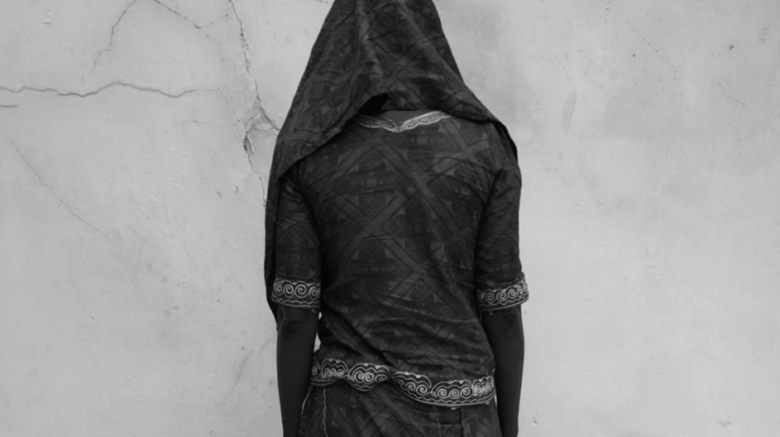
GN, now a young woman, survived years of Boko Haram captivity and around 13 months in unlawful military
detention. Maiduguri, Borno State, July 2023
Source: Amnesty International
AUTHOR: Eleonore Dlugosz Donnen
Boko Haram, whose name means “Western education is a sin” in Hausa, a Chadic language spoken in West Africa. It is a jihadist armed group that emerged in north-eastern Nigeria, whose violence has spread beyond the country’s borders to other nations in the Lake Chad region, affecting Cameroon, Niger and Chad as well. This group became radicalised before establishing itself as an armed insurgency that continues to fight against Nigerian forces to this day. By attacking communities, Boko Haram has raised the attention of Amnesty International, the latter tried to give a voice to the victims through the publication of numerous reports from 2015 to 2025.
Before Boko Haram
Abduction
Kidnapping is one of Boko Haram’s most used weapons against the population, but it is primarily a weapon used against women and girls. Methodical and brutal, the attacks follow a set pattern: fighters arrive, round up the local inhabitants, and separate the men; most are killed on the spot, and the women and children are taken away. Schools are also prime targets, as they are home to future child soldiers and unmarried young girls. Moreover, this instills fear in the collective psyche. Education, which Boko Haram considers a sin, thus becomes a threat. It is dangerous to send children to school.
“Boko Haram entered Mugi and came into our house. (…) They shot my father in the back of
his head and the bullet came through his eyes. We started crying. They said if we don’t keep
quiet, they will kill my mother too”
CB, abducted at 13 years old
But kidnappings are not always large-scale raids on villages. Sometimes, specific individuals are targeted. Informing on others does happen and fuels these kidnappings. If young girls are considered ‘marriageable’, they are reported to Boko Haram.
“There was a man in our neighbourhood who joined (Boko Haram), and he informed them
there was a young girl in our house good for marriage. They (Boko Haram) came to the
house, searched it and found me. That night, they married me off to one of them”
NC, 12 years old at the time
Within Boko Haram
Life as survival
Once abducted, the young girls face a life in captivity. Boko Haram has two options for them: total submission or punishment. The rules imposed by the group are strict and arbitrary; any violation, whether real or merely perceived, results in public corporal punishment. By punishing one woman, they instill fear in the others. Nearly 30 girls interviewed by Amnesty International reported being forced to witness floggings, amputations and even beheadings. These scenes have left them with indelible trauma.
“Sometimes I dream about the corpses that I saw or the stoning of the women that I saw”.
GH, spent 10 years in captivity
Women’s roles can be perceived as those of slaves; they are expected to serve their husbands, both domestically and sexually. They sometimes assist other women in childbirth and with other logistical tasks, but they are confined to small spaces for most of the time. Their lives are not simply lived; they are negotiated hour by hour.
Flesh as a Battleground
Whilst isolation and survival are the daily reality for Boko Haram’s victims, women and their bodies become the property of Boko Haram. Forced marriage is the norm and is imposed from the very first days of captivity, sometimes even before the girl has reached puberty. Thirteen girls interviewed by Amnesty International reported having been forcibly married on several occasions – seven times, twice, six times, three times – with each instance of widowhood, following the death of a husband, automatically leading to a new forced marriage after a period of mourning known as iddah.
“My husband wanted to get intimate with me, but I refused. So he would report me to the
people, and they would call me and flog me. (…) Then he would force himself (inside me),
the friends would help him (…), they would hold my hands and then my legs and then he
would fall on me (…) he did this for almost one year with his friends.
HA, a teenage girl who had “agreed” to be married so she could save her father.
33 survivors have told Amnesty International that they were raped; most of the rapes took place before their periods or shortly afterwards. If sex is a weapon, so is pregnancy. Boko Haram punishes women who try to avoid becoming pregnant.
“She had stayed long without getting a baby. (Boko Haram) tied her and stoned her until she
was dead”
GH, forced to act as a midwife, recounts that she witnessed the execution of two women
who had taken contraceptives.
28 girls interviewed by Amnesty International claim to have given birth to a child conceived as a result of sexual violence; 20 of these girls were themselves children at the time of giving birth. Under international humanitarian law, this constitutes the war crime of forced pregnancy.
Whilst women’s bodies are treated as sexualised objects, they are also subjected to torture, as Boko Haram has also turned girls into human bombs. Between 2014 and 2019, the majority of suicide bombers were women and girls. These suicide missions, which targeted camps for displaced people and checkpoints, were sometimes used as a punishment for a girl who had refused to marry.
“They put us in a suicide jacket. (…) The other woman tried to set off the jacket but couldn’t.
(…) After two days, the military took us to a hospital in Bama”
“I said I would not marry (…) that is why they sent me for suicide, they said maybe that
would give me some redemption”.
AE, 16 years old
“On my way, I met soldiers at the checkpoint (…) When the soldiers were coming towards
me, I said “Don’t come close to me, I’m carrying a bomb with me” That is when they decided
to come and untie the bomb.”
GE, who went to a military checkpoint rather than detonating it in a crowd of people.
Beyond Boko Haram
The Escape
Amidst all this violence, fleeing Boko Haram is neither easy nor a spur-of-the-moment decision. It is like a strategy that must be carried out in the utmost secrecy. Some have had to wait years – for a husband to go off to fight, or for a moment when they would be trusted for a little– whilst others have pretended to be ill to evade surveillance.
“We went with women and checked places (to escape). (We) kept doing that until they stopped
following us…They went to fight. Then the women and I went out of the village”.
GH and other captives.
“I escaped by telling the emir that I wanted to go collect a message from my mother in
Gobara (…) I left with two other women. The emir did not suspect us because he had allowed
us in the past to go places, and we returned. There was no sign that we were planning to
escape.”
“On the way, we encountered several Boko Haram members but always told them that we
were going to see our parents in Ngoshe, (..) that was also controlled by Boko Haram, so they
allowed us passage since (they thought) we were not going outside their territory”
NC, a teenage girl who used a ruse to get past Boko Haram’s internal checkpoints
The Return
Although these victims may appear to be free after escaping Boko Haram, returning home is not a liberation. For many, it is a new ordeal. Some women “rescued” by Nigerian army soldiers are placed in illegal detention, sometimes for several days, sometimes for four years. The Giwa barracks in Maiduguri is one of the most well-documented sites of such arbitrary detention. Women have given birth there and have seen their children die there.
“The soldiers came and took me to the health facility and I delivered there. They gave me
Pampers and clothes for the baby, but it was a little”
BB, who was detained in Giwa at the age of 16, remained in Giwa for forty days before
being released.
Those who were not detained were sent to overcrowded and underfunded camps for displaced people, where stigma is rife. Families refused to see them again and rejected them because they had been with Boko Haram.
Nearly 30 women report having been illegally detained by the army, and some recount being insulted by soldiers who called them “Boko Haram wives” and accused them of murder. The Nigerian army, in its response to Amnesty International, denies these allegations and describes them as “intrinsically unreliable”.
“My mother said she can’t take the insults, so she decided we should leave. My mother
decided to take us to another village where nobody knows us”
BN, abandoned by her uncle after being released from military detention.
The Support?
Despite the resilience of the girls and women who have survived Boko Haram, they have for years faced systematic indifference from the authorities. Unfortunately, the Nigerian government has so far failed to put in place reintegration programmes tailored to their needs. Some have even been reunited with their husbands—former Boko Haram members who have repented—without their consent having been sought.
“Most people at the government don’t care about us. We need support”
AV, 15 years back from captivity
These women want financial independence and want to build a life for themselves outside the overcrowded camps.
“I want to forget that I once lived with Boko Haram. I want to come out of this camp and
start all over again”
EE, survivor
These women, who have survived abduction, sexual slavery, forced pregnancy, suicide bombings and the rejection of their aspirations, must be able to rebuild their lives. EE’s words resonate and are disarmingly simple: they need a starting point. These words seek to restore to these women and girls the support that has been denied them by the post-Boko Haram world. Documenting these serious violations of international humanitarian law must be able to elicit a response commensurate with their gravity.
Amnesty International has in 2024 filed a request with the judges of the International Criminal Court (ICC) to open an investigation into war crimes and crimes against humanity committed in Nigeria. In 2020, the ICC Prosecutor concluded that all the criteria had been met to open an investigation into the atrocities committed since 2010. Yet four years later, the ICC Prosecutor’s Office has still not issued an initial request.
“The International Criminal Court” must not allow Nigeria to be forgotten.”
Isa Sanusi, Director of Amnesty International Nigeria
Sources
Amnesty International. (2015). Boko Haram : l’essor d’une secte. Amnesty International Suisse. Amnesty International Suisse
Amnesty International. (2024, March 28). Nigeria. La CPI ne doit pas briser les espoirs des victimes d’atrocités commises par l’armée. Amnesty International
Amnesty International. (2024, June 9). “Help us build our lives”: Girl survivors of Boko Haram and military abuses in north-east Nigeria. Amnesty International USA. Amnesty International USA
Amnesty International. (2024, June 9). Nigeria: Girls failed by authorities after escaping Boko Haram captivity – New report. Amnesty International USA. Amnesty International USA
Amnesty International. (2024, December 2). Nigeria: Amnesty International petitions ICC judges to end Prosecutor’s delaying of justice for atrocity crimes. Amnesty International
Amnesty International. (2024). [Document POL 10/7200/2024]. Amnesty International Document
Amnesty International. (2024). “Help us build our lives”: Girl survivors of Boko Haram and military abuses in north-east Nigeria (AFR 44/7883/2024). PDF Report
Amnesty International. (2025). [Document POL 10/8515/2025]. Amnesty International Document
Amnesty International France. Nigeria. Amnesty International France
Amnesty International France. Nigeria : des jeunes filles rescapées qui ont échappé à Boko Haram. Amnesty International France
Amnesty International. Nigeria must empower girl survivors of Boko Haram. Amnesty International Petition