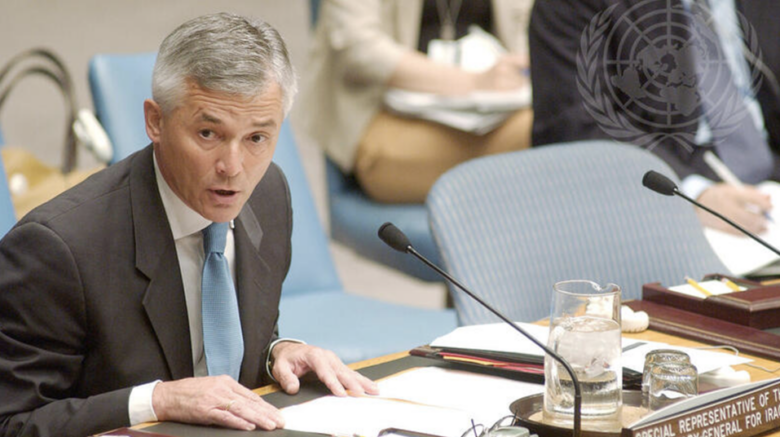
Sergio Vieira de Mello as he addresses the Security Council.
Source : UN Photo, photo by Mark Garten, 22 July 2003.
https://media.un.org/photo/en/asset/oun7/oun7775363
AUTHOR: Eleonore Dlugosz Donnen
Sergio Vieira de Mello was a man who cannot be reduced solely to his role as a diplomat. Yet his life is a chronicle of diplomatic events that demonstrate resilience and the ultimate sacrifice in the service of humanity. He was the man behind the title of United Nations envoy whom we must remember. In a world where crises are multiplying and violence is raining down on populations, with human rights being eroded ever further, it seems necessary, if not vital, to remember the role models of the past who, sometimes at the risk of their own lives, left an indelible mark on the collective psyche Sergio Vieira de Mello is one such man.
From Rio de Janeiro to Geneva, The Man
Born in Rio de Janeiro in 1948, Sergio is a man shaped by a philosophical education at the Sorbonne in Paris, where, more than academic knowledge, he developed an insatiable intellectual curiosity that would become the foundation of his work. He became deeply involved in politics in 1969, joining the United Nations when he was just 21 years old. Whilst the international bureaucrat may be seen as a man behind a desk who observes tensions without going much beyond distant reports on the situation on the ground, Sergio is a diplomat in the field, a man who, beyond his titles, had developed the ability to listen and understand, regardless of who he was speaking to. A man who demonstrated a moral responsibility, particularly towards refugees who could not be protected during conflicts.
“I felt our office, in particular, in those days, UNHCR, (…) had an obligation, almost a moral and historical obligation to succeed in returning refugees after failing in protecting them”
Sergio Vieira De Mello
He speaks not merely of an administrative duty but of a moral obligation towards humanity, a conviction that drives him to take risks to defend the most vulnerable with integrity. Sergio is a man whose legacy cannot be found in treaties or missions, but whose diplomacy is rooted in an unconditional respect for human dignity.
From Refugee Camps to Fractured States: The Career
Sergio’s career has been something of an odyssey, during which the diplomat has had to navigate his way through some of the bloodiest conflicts of the 20th century. From South-East Asia to the Balkans, he has been on the ground, striving to establish a UN presence and safeguard the rights of local populations; in Cambodia, he led repatriation operations, a successful model of civil administration that earned him a reputation as an effective crisis manager. But it was in East Timor that his diplomatic skills truly shone. In torn territories, establishing institutions and systems requires the ability to work hand in hand with local populations.
“He is taking on one of the most difficult challenges in the system, but challenges are nothing new to him. As you know, he has just completed his difficult assignment in East Timor, which he accomplished brilliantly.”
Kofi Annan, Secretary-General of the UN
A diplomatic approach characterised by collaboration with civil society. He had established that the United Nations needed to be able to rely on essential partners such as non-governmental organisations. This was evidence of his determination to embody a form of diplomacy that joins forces with other actors and employs different methods, whilst remaining focused on a shared commitment to peace.
“Peacekeeping and peace-building. All of these activities of the United Nations would be impossible without the active involvement of non-governmental organizations, both advocacy and operational non-governmental organizations. We have a long history of partnership with them. We do not necessarily agree on everything; occasionally we disagree on tactics, but we never disagree on principles. We are used to working together in a very transparent, fluid and, when necessary, critical way.”
Sergio Vieira De Mello
An exemplary career, characterised by an approach that has always been focused on others, has earned him widespread acclaim as a devoted champion of humanity and conflict resolution.
“Throughout his career he has been an outstanding servant of humanity, dedicated to relieving the suffering of his fellow men and women, helping them to resolve their conflicts and rebuild their war-torn societies.”
Kofi Annan, Secretary-General of the UN
From New York to the Canal Hotel, The Attack
In 2003, Sergio accepted a mission – his final mission – as the Secretary-General’s Special Representative in Iraq. He arrived in Baghdad and worked tirelessly to restore stability to the country, ensuring that post-invasion reconstruction placed human rights and respect for Iraqi sovereignty at its very heart. Yet danger was ever-present, but he refused to leave, convinced that the UN presence was necessary – a total commitment in which he spent days negotiating with the various factions and gave speeches attempting to build a fragile consensus despite the hostile environment. On 19 August 2003, a terrorist attack destroyed the Canal Hotel, which housed the headquarters of the UN mission, killing Sergio and 21 members of UN staff. After the bomb, Sergio remained trapped in the rubble; it was at that moment that he said his final statement.
“Don’t let them pull the mission”
Sergio Vieira de Mello
These final words, spoken to an American soldier who was trying to rescue him, bear witness to his commitment: despite being in extreme pain, he refused to abandon the mission or the Iraqi people, even as he lay dying.
The attack has been condemned as an act of violence aimed at undermining efforts to stabilise Iraq. Sergio’s death marks a turning point in the history of humanitarian diplomatic action; it highlights the vulnerability and sacrifice of United Nations workers, but also the need for those who follow to be able to continue this unfinished mission. Many have spoken out to praise his sacrifice.
“Those who killed him have committed a crime, not only against the United Nations but against Iraq itself.”
Kofi Annan, Former Secretary-General of the UN
In addition to statements from UN staff, others have been speaking out publicly.
“The brutal murder of Sergio Vieira de Mello is further proof that those who serve humanity and defend human rights are easy targets in a world where the security of states is valued more than the security of human beings.”
Irene Khan, Secretary Generalof Amnesty International
From Tragedy to the Screen, The Camera Lens
Even directors of films wanted to pay a tribute to the diplomat like Greg Barker, who released in 2009 a documentary called “Sergio”. Featuring a wide range of testimonies about him. From his partner Carolina to the American soldier who spoke to him before his death, and UN staff, many of those interviewed speak highly of Sergio’s work and the man he was. However, the documentary focuses primarily on his death; his diplomatic efforts are scarcely documented, and the film concentrates mainly on the tragedy of the final days of his life, with a detailed, step-by-step account of the attack on Sergio right up until he drew his last breath. His mother gives a poignant testimony, expressing the pain of a mother who has lost her son and, more broadly, of a world that has lost an ambassador for peace.
The second film, also titled “Sergio” and directed by the same director, was released in 2020. It features a cast of well-known actors: the Brazilian actor Wagner Moura in the role of Sergio, alongside Ana de Armas, the Cuban-Spanish actress who plays Carolina, his partner. This film focuses on their love story, how they met, and the tragic fate that would separate them. Although it recounts Sergio’s life, it is primarily a drama, making it more accessible to viewers who are less interested in the factual nature of the testimonies and more drawn to the cinematic format.
Two works that seek to commemorate the memory of Sergio and the man he was, as well as his tragic death, a sacrifice that left the world in mourning.
Sergio remains in the collective psyche as an iconic figure of humanitarian diplomacy; the day of his death, 19 August, has even become World Humanitarian Day. A day of remembrance which, beyond mourning, serves as an annual call to protect those working in crisis zones.
A Brazilian man who gave his life for diplomacy. Sergio Vieira de Mello.
“As for you, the people of Brazil, your flag is flying at half mast today, because you have lost one of your finest sons.”
Kofi Annan, Secretary-General of the UN
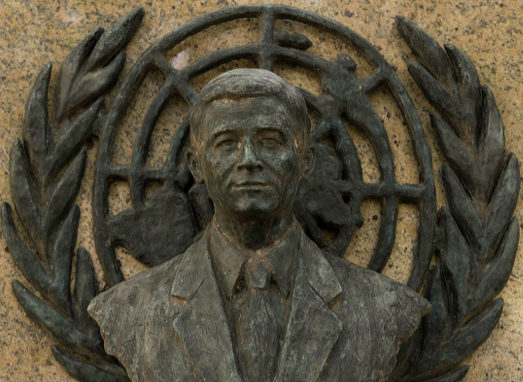
Statueof Sergio Vieira de Mello in his hometown Rio de Janeiro
Source: Wikimedia Commons, photograph by Donatas Dabravolskas, licensed under CC BY-SA 4.0.
https://commons.wikimedia.org/wiki/File:Sérgio_Vieira_de_Mello_-Rio_de_Janeiro-_20230823080201.jpg?uselang=fr
Sources
Amnesty International. (2003). Informe sobre el atentado en Bagdad y la muerte de Sergio Vieira de Mello [Report on the Baghdad attack and the death of Sergio Vieira de Mello]. https://www.amnesty.org/es/wp-content/uploads/sites/4/2021/06/mde141622003es.pdf
Office of the United Nations High Commissioner for Human Rights. Sergio Vieira de Mello. https://www.ohchr.org/en/about-us/high-commissioner/past/sergio-viera-de-mello
United Nations. (2002). Statement by the Secretary-General (SG/SM/8318). https://press.un.org/en/2002/sgsm8318.doc.htm
United Nations. (2003, August 19). Secretary-General’s statement on the death of Sergio Vieira de Mello. https://www.un.org/sg/en/content/former-secretary-general/statements/2003-08-19/secretary-generals-state ment-the-death-of-sergio-vieira-de-mello
United Nations. (2003). Report of the United Nations High Commissioner for Human Rights and follow-up to the World Conference on Human Rights (E/CN.4/2003/14). United Nations Digital Library. https://digitallibrary.un.org/record/519108
United Nations. (2003). Press release SG/SM/8829. https://press.un.org/en/2003/sgsm8829.doc.htm
United Nations. (2003, August 2003). Top UN envoy Sérgio Vieira de Mello killed in terrorist blast in Baghdad. UN News. https://news.un.org/en/story/20063/08/77212-top-un-envoy-sergio-vieira-de-mello-killed-terrorist-blast-ba ghdad
United Nations. (2003, August 2003). UN envoy Sergio Vieira de Mello begins final journey home. UN News. https://news.un.org/en/story/2003/08/77442-un-envoy-sergio-vieira-de-mello-begins-final-journey-home
United Nations. (2003). Report of the United Nations High Commissioner for Human Rights (E/CN.4/2003/14). United Nations Digital Library. https://digitallibrary.un.org/record/519108?v=pdf
United Nations. (2003). Press release SG/SM/8318. https://press.un.org/en/2002/sgsm8318.doc.htm
United Nations. (2013). Statement SG/SM/14841. https://press.un.org/en/2013/sgsm14841.doc.htm
United Nations. Humanitarian Day. https://www.un.org/en/observances/humanitarian-day
Vieira de Mello, S. (2003). Report of the United Nations High Commissioner for Human Rights. United Nations Digital Library. https://digitallibrary.un.org/record/519108