AUTHOR: Eleonore Dlugosz Donnen
“For the people of Sudan, nowhere is safe.”
Amnesty International
Sudan is, regrettably, invoked whenever violation of human rights is mentioned, so it is necessary to use this blog to shed light on unfolding realities of this devastating conflict.
Since 2023, the East African state has been plunged into an armed crisis between the Sudanese Armed Forces (SAF) and the Rapid Support Forces (RSF), the successor to the Janjaweed militias. The conflict has spread, ravaging Khartoum and the states of Darfur, Kordofan, and Gezira in its
wake.
Marked by numerous successive power struggles that have seen coups, civil wars, and genocides, two distinct camps continue to expose the civilian population to their actions on a massive scale.
The RSF, formed under former President Omar al-Bashir and created to suppress rebellions in Darfur, subsequently established itself as an autonomous military actor, working alongside the SAF. A conflict then broke out between the two groups, and this split plunged the country into a growing security crisis in which no civilian was left unscathed.
Beyond military clashes, the conflict has taken on the dimension of systematised violations of international humanitarian law, with attacks destroying civilian infrastructure, including hospitals. In Amnesty International’s 2023 report ‘Death Came to Our Home: War Crimes and Civilian Suffering in Sudan’, Amnesty International documented extensive war crimes being committed by the SAF and RSF in the conflict.
In West Darfur, research concludes that ethnic attacks targeting Masalit communities in the towns of El Geneina, Ardamata, Misterei and Tandelti have been documented. To offer you some background, the Masalit are one of the major non-Arab ethnic groups and were, for the past years, subjected to ethnic violence by the Arab militias that later evolved into the Janjaweed and then the RSF. Converging testimonies do attribute this violence to the RSF and allied armed militias. Amnesty International’s report published in 2025 states that the RSF deliberately killed civilians, seized hostages, pillaged property and desecrated mosques.
Chronology of the Conflict
2003, Armed conflict erupts in Darfur; civilians from specific ethnic groups targeted; Janjaweed militias commit crimes under international law.
2013, Rapid Support Forces (RSF) are founded from Janjaweed militias under former President Omar al-Bashir.
April 2019, Omar al-Bashir is removed from power following popular uprisings; Transitional Military Council assumes control.
August 2019, Constitutional Declaration signed to establish a 39-month transitional government.
2021, Military coup dissolves transitional government; state of emergency declared.
2022, Hamdok resigns; military retains full control.
2023, Rising tensions between SAF and RSF over integration into the national army and an open armed conflict erupts between SAF and RSF, fighting spreads across Khartoum, Darfur, North Kordofan and Gezira.
2024, RSF launches offensive on El Fasher, capital of North Darfur.
2025, Major RSF attacks near El Fasher and Zamzam IDP (Internally Displaced Person) camp result in mass civilian casualties.
Amnesty International’s Lens
Amnesty International’s work on the situation in Sudan has documented serious violations of international humanitarian law and international human rights law, placing the voices of victims at the heart of its legal analysis. In its publications on the conflict, Amnesty International recounts individual stories that concretely highlight the reality experienced by civilians, who are the primary witnesses to the violence in the region.
In this context, Amnesty International has positioned itself as a principal moral interlocutor challenging these violations against civilians. This position is supported by Tigere Chagutah, Amnesty International’s regional director for East and Southern Africa.
“The ongoing lack of accountability for past crimes is one of the root causes of this renewed violence. The cycles of horror must be broken, and those responsible for crimes against civilians must be held to account.”
Tigere Chagutah
This statement makes it clear that the current violence is no longer just a temporary disruption, but rather the result of a deeply rooted architecture of impunity. In the absence of credible prosecutions, these crimes allow the perpetrators of serious violations to retain their sense of impunity in a crisis that already appears to be very serious and is continuing to escalate.
“Sudan is the world’s largest displacement and humanitarian crisis, yet the humanitarian response for 2025 is grossly underfunded. This will go down in history as an abject failure unless Sudan’s international partners rise to the occasion and increase emergency funding for the humanitarian response in Sudan, as well as for Sudanese refugees.”
Tigere Chagutah
These words are not just about documenting violations; they reallocate responsibility beyond the battlefield, thus exposing the insufficiency of international commitment. Showing that responsibility is international and does not only concern the parties to the conflict. Although essential, these existing mechanisms, such as the United Nations Security Council’s arms embargo, which is limited to Darfur and not the entire region, have proved to be not enough, and for Amnesty International, one of the determining factors in this violence is the continuous influx of weapons that fuels the violations committed by the parties to the conflict. Amnesty International Secretary General Agnès Callamard herself affirms this requirement.
“The only way to end these violations is to stem the flow of arms to parties to the conflict by expanding the arms embargo that currently applies to Darfur to the rest of the country.”
Agnès Callamard
This position marks an important strategic shift. The arms embargo already in place is considered insufficient and far too limited in geographical scope. The aim is to extend this embargo to the whole of Sudan to significantly reduce the parties’ capacity to commit crimes.
Amnesty International is therefore taking on a role that goes far beyond observation, using public statements to build a case for justice, increased humanitarian funding and an expanded embargo in the hope of breaking the cycles of violence afflicting Sudan.
Chronology of Amnesty International
2003-2004, Amnesty documents Janjaweed crimes against civilians in Darfur.
2023, Death Came to Our Home: War Crimes and Civilian Suffering in Sudan reports extensive war crimes by SAF and RSF.
2024, Research confirms ethnic attacks against Masalit communities in West Darfur; testimonies attribute these crimes to RSF and allied militias.
2025, Amnesty publishes survivor testimonies from El Fasher detailing executions, beatings, hostage-taking, rape and sexual violence; calls for accountability for war crimes and crimes against humanity.
Focus on Rape as a Weapon of War, Irreversible Consequences on Flesh
Among the numerous violations documented, sexual violence has emerged as one of the most devastating patterns of abuse. These acts that are not the result of armed confrontation but part of a pattern of terrorisation directed at civilians, and to be precise, directed at women and girls. Rape in Sudan is not a by-product of war but a method to fracture the Sudanese population.
Important!
Trigger Warning: The following testimonies may be very difficult to read. They describe sexual violence committed in the context of armed conflict.
According to research conducted by Amnesty International, the survivors interviewed describe unparalleled violence with irreversible consequences, inscribed upon their bodies and futures.
“Women are not leading or participating in this war, but it is women who are suffering the most. I want the whole world to know about the suffering of Sudanese women and girls and ensure that all the bad men who raped us are punished. I cannot cope with that.”
A survivor of sexual violence in Omdurman
Conveying a powerful message, her words speak a stark truth. Women did not engineer this war, yet they are on the front lines, suffering the most intimate and destructive forms of this war. Rape is a punishment, a tool of terror.
Another woman shares that three armed men in civilian clothing assaulted and forced her in El Geneina, where they took turns raping her.
“There is no safety anywhere […] had to go back home to get a blanket for my daughters, and these criminals raped me. Now I am terrified that I could be pregnant.”
Survivor
While she had gone out to fetch a blanket for her children, this maternal gesture turned into irreversible trauma. The fear of this forced pregnancy became a second trauma, a prolonged act of the original violence.
A father described how two members of the RSF burst into his home in Omdurman, forcing him outside at gunpoint and then raping his 16- and 17-year-old daughters for more than two hours.
“When they left, my daughters were in bad condition. There was no functioning hospital near us, and it was too dangerous to try to go around the city. There was fighting everywhere. So, the girls could not receive any medical care.”
The father of two teenage girls raped in Omdurman
This testimony exposes violence enacted with near-total impunity and underscores the collapse of the healthcare system, which prevents any medical and psychological care from being provided, despite the extreme need for it. Rape is violent and is followed by institutional abandonment. The victims are left alone in enforced isolation.
One last example of testimony is that of Ibtisam, who fled El Fasher with her children and was intercepted by RSF fighters.
“One of them forced me to go with them, cut my Jalabiya, and raped me.”
Ibtisam, survivor from El Fasher
A few hours later, her 14-year-old daughter approached her.
“She came to me and said, ‘Mum, they raped me too, but do not tell anyone.”
Ibtisam
Ibtisam’s daughter fell ill shortly afterwards and died.
To read these stories is devastating and transcribing them faithfully word for word is just as unbearable, but because it is essential to understand that impunity thrives in silence, this invisibility of the crime is a shield for the perpetrators.
Where those targeted dared to speak up, on the other hand, the RSF has stated that it rejects the accusations and claims to have put internal investigation mechanisms in place. Nevertheless, according to Amnesty International, no evidence has been provided regarding concrete investigations. In the context of institutional collapse, such absent transparency only allows the impunity and injustice to grow stronger.
Conclusion
Sudan is therefore not just a military confrontation between two forces, but a human catastrophe where impunity fuels an endless cycle of violence. Amnesty International names the victims, documents the facts and repeatedly raises the alarm of indifference. Security can only be restored
through concrete decisions such as humanitarian funding commensurate with the crisis, effective prosecution of war criminals and a comprehensive cessation of arms transfers.
For as long as the world averts its gaze, survivors will remain suffocated beneath atrocities, and the Sudanese soil will continue to bleed.
Sources:
Amnesty International. Destruction and violence in Sudan.
https://www.amnesty.org/en/projects/sudan-conflict/
Amnesty International. Sudan: Civilians suffering “unimaginable horror” amid ethnically motivated violence in Darfur.
https://www.amnesty.org/en/latest/news/2023/11/sudan-civilians-suffering-unimaginablehorror-amid-ethnically-motivated-violence-in-darfur/
Amnesty International. Sudan: “Death came to our home”: War crimes and civilian suffering in Sudan (Report No. AFR 54/7037/2023).
https://www.amnesty.org/en/documents/afr54/7037/2023/en/
Amnesty International. Sudan: El Fasher survivors tell of deliberate RSF killings and sexual violence – new testimony. https://www.amnesty.org/en/latest/news/2025/11/sudan-el-fasher-survivors-tell-of-deliberate rsf-killings-and-sexual-violence-new-testimony/
Amnesty International. Sudan: ICC conviction of Ali Muhammad Ali Abd-Al-Rahman should serve as warning to others committing abuses amid ongoing conflict. https://www.amnesty.org/en/latest/news/2025/10/sudan-icc-conviction-of-ali-muhammad-aliabd-al-rahman-should-serve-as-warning-to-others-committing-abuses amid-ongoing-conflict/
Amnesty International. Sudan: Rapid Support Foorces’ ruthless attack on Zamzam camp should be investigated for war crimes. https://www.amnesty.org/en/latest/news/2025/12/sudan-rapid-support-forces-ruthless-attack on-zamzam-camp-should-be-investigated-for-war-crimes/
Amnesty International. The state of the world’s human rights: April 2025 (Report No. POL10/8515/2025). https://www.amnesty.org/en/documents/pol10/8515/2025/e
Source picture
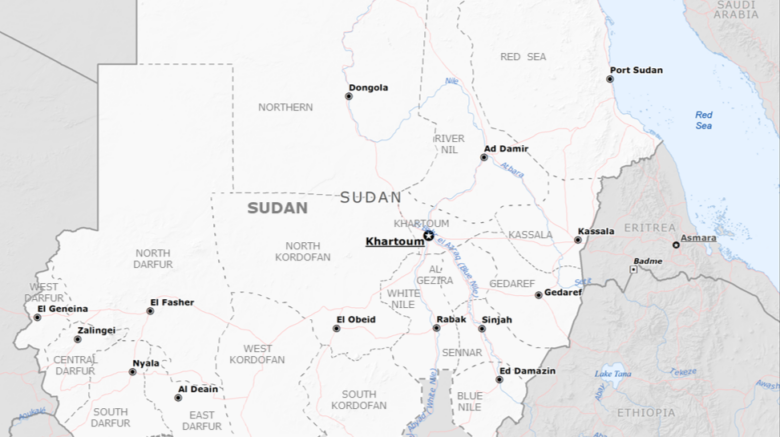
Map of Sudan – ECHO Sudan Editable A4 Landscape” by ECHO, licensed under CC BY 4.0 https://commons.wikimedia.org/wiki/File:ECHO_Sudan_Editable_A4_Landscape.png