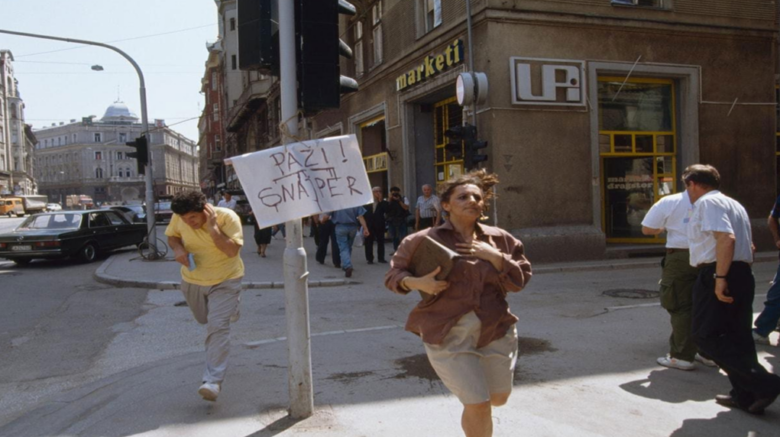
“Pazi! Snajper!” (“Beware! Sniper!”) sign displayed in Sarajevo during the 1992–1995 siege.
AUTHOR: Adriano Barbaro
Often historical human rights violations are not given the space and attention they deserve. However, that does not make them irrelevant and or not worth remembering. There always is something to learn from the past, and as history has shown us, sometimes the past can return and impact our present, and why not, our future. In some way, that is the case of the Sniper Tourism during the 1,425- day siege of Sarajevo in the context of the Yugoslavian Wars. Recently, thanks to the ongoing investigations on possible participants in this atrocious activity, new details have been revealed.
The Siege of Sarajevo and the Sniper Alley
For nearly four years, Sarajevo’s civilian population endured one of the longest sieges in modern history. The siege took place during the Bosnian War, following the collapse of Yugoslavia and Bosnia and Herzegovina’s declaration of independence in 1992. Sarajevo was surrounded by the Army of the Respublika Srpska, supported by the Yugoslav People’s Army, as Bosnian Serb forces fought against the newly independent Bosnian state. Snipers were the most feared, as they could spot people on the streets, markets and residential areas, and shoot them from long distance. This constant danger turned everyday life into a struggle for survival. More than 10.000 people were killed and children were not spared. One of the main street directly leading to the airport of Sarajevo, Meša Selimović Boulevard, which later became known as “Sniper Alley”, came to symbolise this reality in which civilians risked being shot while crossing the street, going to work or collecting humanitarian aid. Far from being incidental casualties of war, many of these attacks formed part of a broader campaign of terror against the civilian population, in violation of international law and fundamental human rights.
War Tourism and its Darkest Sides
Beyond the shelling and sniper fire that terrorised Sarajevo’s civilians, the siege also became associated with allegations of a particularly disturbing phenomenon often referred to as “War Tourism” or “Sniper Tourism”. According to survivor testimonies and recent investigations, foreign individuals allegedly travelled to the hills surrounding Sarajevo, where the Bosnian Serb forces were located and sniper posts were positioned in strategic points overlooking the city. Some reports claim that these visitors paid large sums of money to the Bosnian Serb to fire weapons at the besieged city, turning civilian suffering into their own amusement. In 2016, the Bosnian Serb leader Radovan Karadžić was found guilty on one count of genocide, five counts of crimes against humanity and four counts of war crimes during his role in the conflict. John Dalhuisen, who is Amnesty International’s Director for Europe and Central Asia, stated that this judgement confirms Karadžić’s responsibility for what he describes as “the most serious crimes under international law carried out on European soil since the Second World War” (Amnesty International, 2016). It is important to notice that the Court convicted Karadžić of genocide in relation to the Srebrenica massacre. Around five years later, also Ratko Mladić, the commander of the Bosnian Serb Army, was found guilty of genocide, crimes against humanity and war crimes.
Amnesty reports clearly establish the broader reality in which Sarajevo’s civilians were systematically exposed to unlawful attacks, fear and terror. Within this context, the idea that outsiders may have participated in or observed violence against civilians highlights one of the darkest forms of the commodification of war. This turned the siege into a spectacle rather than as a humanitarian catastrophe marked by grave human rights violations.
Present-Day Accountability
Although this is not an ongoing phenomenon, recent investigations have brought renewed attention to allegations of sniper tourism during the siege of Sarajevo. The 2022 Sarajevo Safari documentary, directed by Miran Zupanič, revived public awareness of these claims. Many were faced for the first time with the existence of such practice, in which some foreigners may have treated the suffering of Sarajevo’s civilians as a form of wartime entertainment. In November 2025, the Guardian reported an ongoing investigation from prosecutors in Milan, who are looking into Italians who allegedly paid Bosnian Serb soldiers to travel to Sarajevo and shoot civilians for pleasure. Since then, multiple individuals have been investigated. Reuters later reported that an 80-year-old former truck driver living near Pordenone had become the first identified individual in the Italian inquiry. The alleged route involved people travelling through Trieste and Belgrade before being taken to sniper positions around Sarajevo. Italian prosecutors are reportedly examining possible crimes such as voluntary murder aggravated by cruelty and vile motives. Recent reports suggest that in May 2026, Austrian authorities have opened investigations into two individuals suspected to be involved in similar sniper tours.
More than thirty years later, the victims of Sarajevo still deserve truth, justice and recognition. These ongoing investigations may not erase the suffering endured during the siege, but they represent an important step towards accountability for acts that reduced human lives to targets and entertainment. It is hoped that uncovering these truths will encourage other countries to pursue similar investigations and ensure that such crimes are neither forgotten nor ignored.
Sources
Amnesty International. (1994). Bosnia-Herzegovina: Shelling of civilians queuing for humanitarian aid in Sarajevo (Dobrinja), 16 June https://www.amnesty.org/en/documents/EUR63/003/1994/en/ 1994.
Amnesty International. (1994). Bosnia-Herzegovina: Further information on shelling of civilians in Sarajevo (marketplace attack). https://www.amnesty.org/en/documents/eur63/004/1994/en/
Amnesty International. (2012, April 6). Bosnia’s war crimes should haunt Europe. https://www.amnesty.org/en/latest/campaigns/2012/04/bosnias-war-crimes-should-haunt-europe/
Amnesty International. (2016, March 24). Karadžić verdict: War crimes in the Bosnian war. https://www.amnesty.org/en/latest/news/2016/03/karadzic-verdict-war-crimes-bosnian-war-2/
Amnesty International. (2019). Bosnia and Herzegovina: Submission to the UN Universal Periodic Review (3rd cycle). https://www.amnesty.org/en/documents/eur63/0499/2019/en/
Amnesty International. (2021, June 8). Bosnia and Herzegovina: Mladić verdict an historic day for international justice. https://www.amnesty.org/en/latest/news/2021/06/bosnia-and-herzegovinamladic-verdict-an-historic-day-for-international-justice-2/
Source(s) image(s)
Amalvy, V. (1992, August). Sarajevo sniper warning [Photograph]. Getty Images. https://www.gettyimages.com/